
Chevrolet Silverado EV Price: Why Fleet Quotes Diverge from the Launch MSRP
When the Chevrolet Silverado EV arrived, its launch MSRP became the figure everyone anchored to. Fleet managers who requested commercial quotes soon found that it rarely matched what they were offered. The difference comes from two separate pricing systems, and it is worth understanding how each one works.
MSRP stands for Manufacturer’s Suggested Retail Price. General Motors sets it for retail buyers, and it assumes a standard configuration, a single unit, and a walk-in sale. It is a reference point, not an agreed price.
Fleet quotes work differently. A commercial offer is negotiated, and the final number depends on configuration, volume commitments, contract structure, and which fleet-sales channel handles the order. Two operators ordering the same model can receive quotes that differ by thousands of dollars. To read the Chevrolet electric truck price landscape, keep the retail reference point separate from the negotiated commercial one.
This article is for fleet buyers and procurement teams evaluating the Silverado EV for commercial duty. It covers how a quote is built layer by layer, which incentive programs reduce it, what upfitting adds after purchase, and how total-cost analysis changes the picture over the life of the truck.
Launch MSRP vs. Fleet Quote: Two Distinct Pricing Systems
The Chevrolet Silverado EV price published at launch is a reference figure, not a transaction. It comes from the manufacturer, applies across a trim lineup, and appears on window stickers and online configurators. Its purpose is comparison: every buyer starts from the same number before taxes, incentives, or negotiation.
A fleet quote is prepared for one buyer, one configuration, and one volume. The same truck can carry two very different numbers depending on who is purchasing and how.
How a Fleet Quote Is Assembled
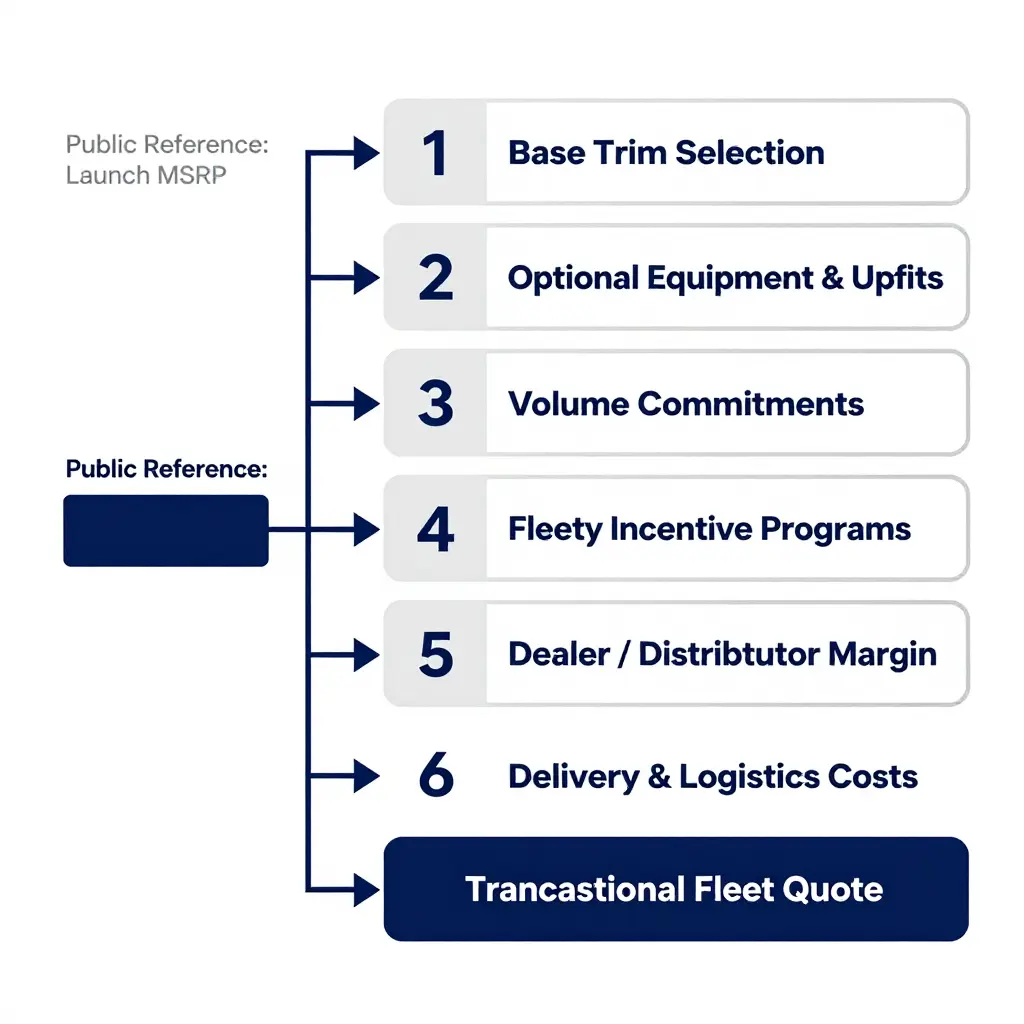
A fleet quote is built in layers, and each layer moves the number away from the public launch MSRP:
- Base trim selection. Commercial trims (such as WT) anchor the quote. Trim choice sets battery capacity, range, payload, and standard equipment, the largest single variable in commercial electric truck pricing.
- Optional equipment and upfits. Telematics, service bodies, toolboxes, and power take-off provisions are added and priced individually.
- Volume commitments. Committed annual purchases can unlock tiered pricing that a single-unit retail buyer never sees.
- Fleet incentive programs. Manufacturer and distributor programs apply as deductions, sometimes rebates, sometimes direct price reductions.
- Dealer or distributor margins. The seller’s compensation is negotiated and embedded in the final number, not in the MSRP.
- Delivery and logistics costs. Freight, preparation, and last-mile delivery to the fleet’s location are added as line items.
Because every quote carries these six layers, comparing two offers means comparing two assemblies, not two prices. The published Chevrolet Silverado EV price stays the public benchmark; the fleet quote is what you actually sign. For a deeper baseline on the Chevrolet Silverado EV price, review our dedicated breakdown before you benchmark any fleet offer.
Key Drivers of Price Divergence
When General Motors published the launch MSRP for the Silverado EV, many fleet managers assumed that figure would anchor their procurement math. The sticker and the number that lands on a commercial purchase order rarely match. Fleet quotes are built deal by deal, and each one reflects its own blend of configuration, incentives, and timing that a single national MSRP cannot capture. For buyers tracking the real-world Chevrolet Silverado EV price, the gap is a structural feature of how commercial vehicles are sold, priced, and delivered, not a rounding error.
- Trim availability differences. The launch MSRP usually spotlights one hero configuration, often a well-equipped retail trim. Fleets, by contrast, frequently need work-truck or mid-tier trims that carry different content and different price tags, so the comparable build may sit above or below the advertised figure.
- Volume-based discounting. Large orders unlock tiered pricing that individual buyers never see. A 50-unit commitment can negotiate meaningful per-truck reductions that a single-unit quote simply cannot match.
- Fleet-only incentive programs. Manufacturers layer fleet allowances, loyalty credits, and commercial rebates on top of, or instead of, retail promotions, and these programs shift month to month, creating quote variability that has nothing to do with MSRP.
- Upfitting and special equipment. Most commercial trucks leave the factory as chassis-cab platforms and receive service bodies, ladder racks, telematics, and power take-off systems afterward, so upfit cost is folded into the delivered price rather than the vehicle sticker.
- Order timing relative to model-year changes. Quotes submitted just before a model-year rollover frequently benefit from end-of-year clearing incentives, while orders placed after a refresh absorb new content, new pricing, and sometimes new mandatory packages.
- Regional dealer or distributor pricing. Freight charges, regional demand, state incentives, and individual dealer margins vary widely by market, meaning two identical specs can quote at surprisingly different totals depending on where the truck is sourced.
Together, these drivers mean a procurement budget should be built on quoted, delivered cost, not on the marketing MSRP. Teams that model a realistic range and revisit it each order cycle avoid the surprise that turns a tidy MSRP into a painful number at signing. For a deeper breakdown of how these figures are assembled, see how the Chevrolet Silverado EV price is structured across commercial configurations.
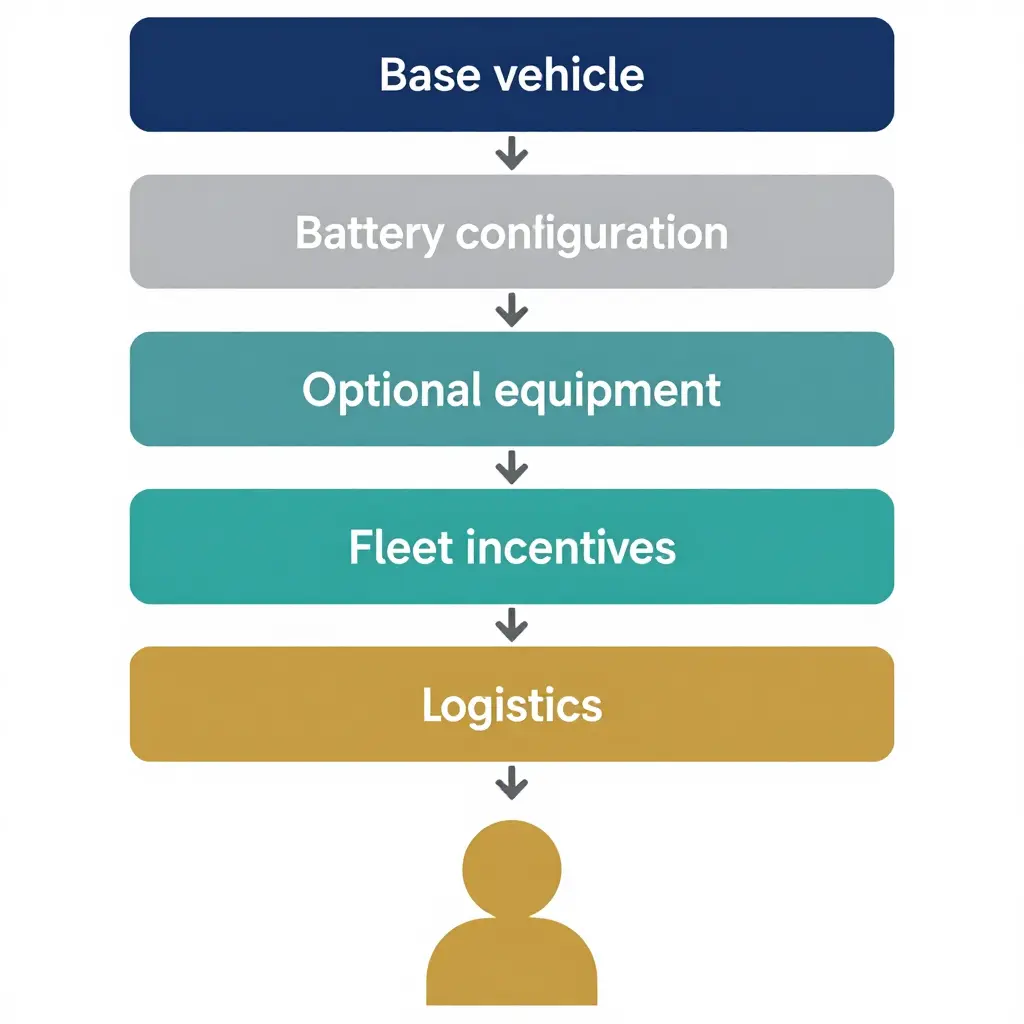
An abstract schematic of how a launch MSRP is built up and whittled down through stacked pricing layers toward a final fleet quote.
Fleet Incentive Programs and Volume Discounting
The launch MSRP is a public reference point, not the price a business pays. For commercial fleet buyers, the effective Chevrolet Silverado EV price comes from a separate incentive system that operates largely outside the retail window sticker.
Retail and fleet incentives serve different buyers and rarely overlap. Retail offers such as cash rebates, subsidized APR, and lease pull-aheads exist to move individual vehicles, and they are advertised to consumers. Fleet programs are contract-based, invoice-driven, and negotiated directly with the manufacturer’s fleet division. A retail cash incentive typically cannot be stacked onto a fleet purchase, and fleet-only rebates usually do not appear in consumer advertising. Comparing Chevrolet electric truck pricing structures helps clarify where the two systems diverge.
Three mechanisms drive that divergence:
- Fleet-only rebates: fixed allowances available only to registered commercial accounts or verified fleet buyers.
- Commercial referral discounts: credits awarded when a business sources vehicles through an approved fleet partner or upfitter network.
- Volume commitments: contractual guarantees to purchase a set number of units over a defined period, which unlock tiered per-unit pricing.
Because these elements are negotiated, fleet quotes vary widely. Two fleet managers ordering similar Silverado EV units can receive substantially different figures based on account tier, order volume, delivery window, upfit requirements, financing structure, and their prior purchasing history with the manufacturer. Enterprise accounts that commit to multi-year volume schedules typically qualify for deeper allowances than a small business placing a single-unit order.
Volume commitments also shift risk. A larger, firmer commitment gives the manufacturer forecasting certainty, and that certainty has a price. Buyers who accept longer delivery windows or standard configurations often pay less than those requesting custom specifications on short notice.
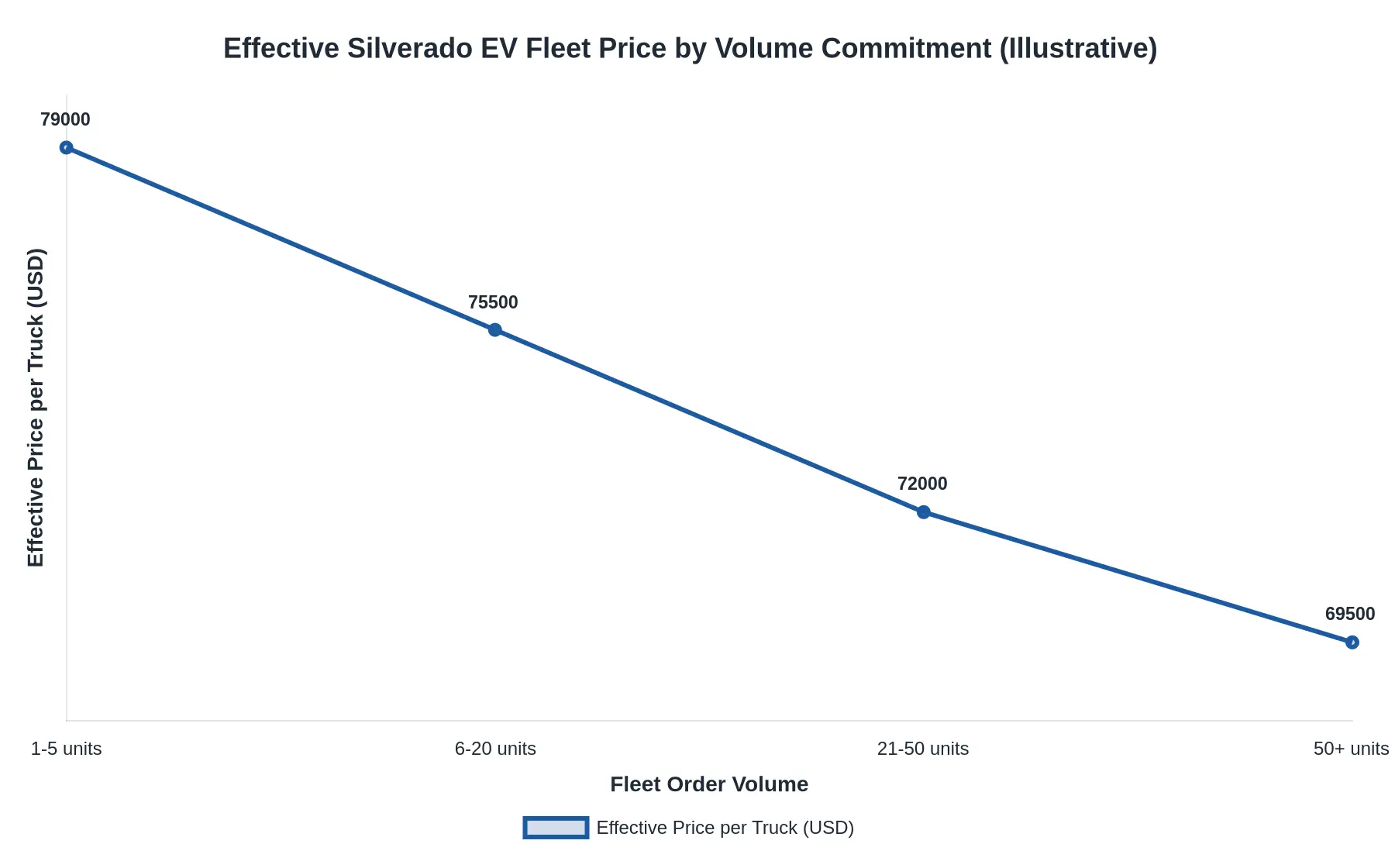
The launch MSRP functions as a ceiling reference. The transaction price comes from the rebates, referrals, and commitments a fleet actually qualifies for. When comparing quotes, request an itemized breakdown that separates base invoice, fleet-only rebates, referral credits, and volume-tier adjustments. The final number reflects the contract, not the sticker.
Upfitting, Configuration, and the Costs the Launch MSRP Leaves Out
For fleet buyers, the headline price on a new Silverado EV is only a starting point. It describes one standardized build, not the upfitted, task-specific vehicle a commercial operator needs. This is where most fleet quotes drift away from the advertised launch MSRP.
Configurator variability drives the first increase
Configuration choices shift the number before a truck ever reaches the shop. Battery-pack size, trim, drivetrain layout, and optional packages each move the baseline. A procurement spec that calls for extended range, all-wheel drive, or a specific payload target lands well above the entry sticker. Comparing current trims and options on our Chevrolet electric truck pricing page shows how fast a baseline can climb.
Commercial upfitting adds the real weight
Upfitting, the work of turning a chassis into a working asset, is the largest reason a final quote exceeds the launch MSRP. Service bodies, utility beds, ladder racks, cranes, refrigeration, and specialized shelving are rarely part of the advertised figure, and neither are the electrical and safety integrations they demand, from auxiliary power management to telematics. Fleet managers evaluating purpose-built units often begin by reviewing electric work trucks configured for commercial duty.
Procurement specifications set the final number
Procurement teams rarely buy a truck; they buy a capability. When a specification mandates a particular box length, seal rating, or 12-volt load profile, the quote is assembled around those requirements rather than the marketing trim. Engineering shapes the number, not advertising. It is also why total-cost thinking increasingly extends into operational planning, as explored in our analysis of the future of commercial electric logistics.
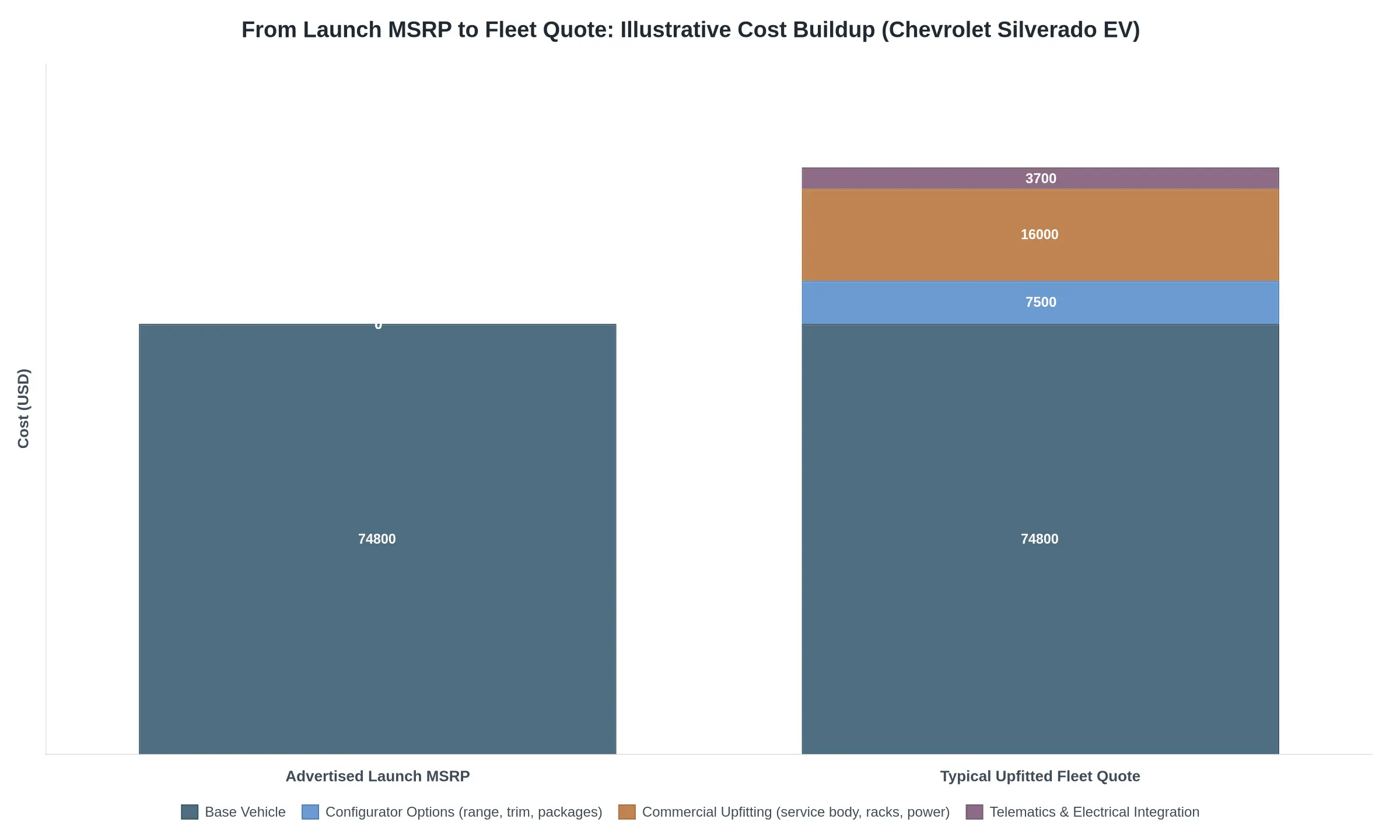
Illustrative cost buildup
The figures below are illustrative and meant to show the structure of a fleet quote rather than any single published price.
| Cost layer | Illustrative amount |
|---|---|
| Advertised base MSRP | $74,800 |
| Configurator options (range, trim, packages) | $7,500 |
| Commercial upfitting (service body, racks, power) | $16,000 |
| Telematics and electrical integration | $3,700 |
| Final upfitted fleet quote | $102,000 |
The takeaway
Treat the launch MSRP as a floor that fleets almost always exceed, not a guarantee. Request a line-item quote that separates the base vehicle, configuration, upfitting, and integration. That is the number that will actually hit your budget.
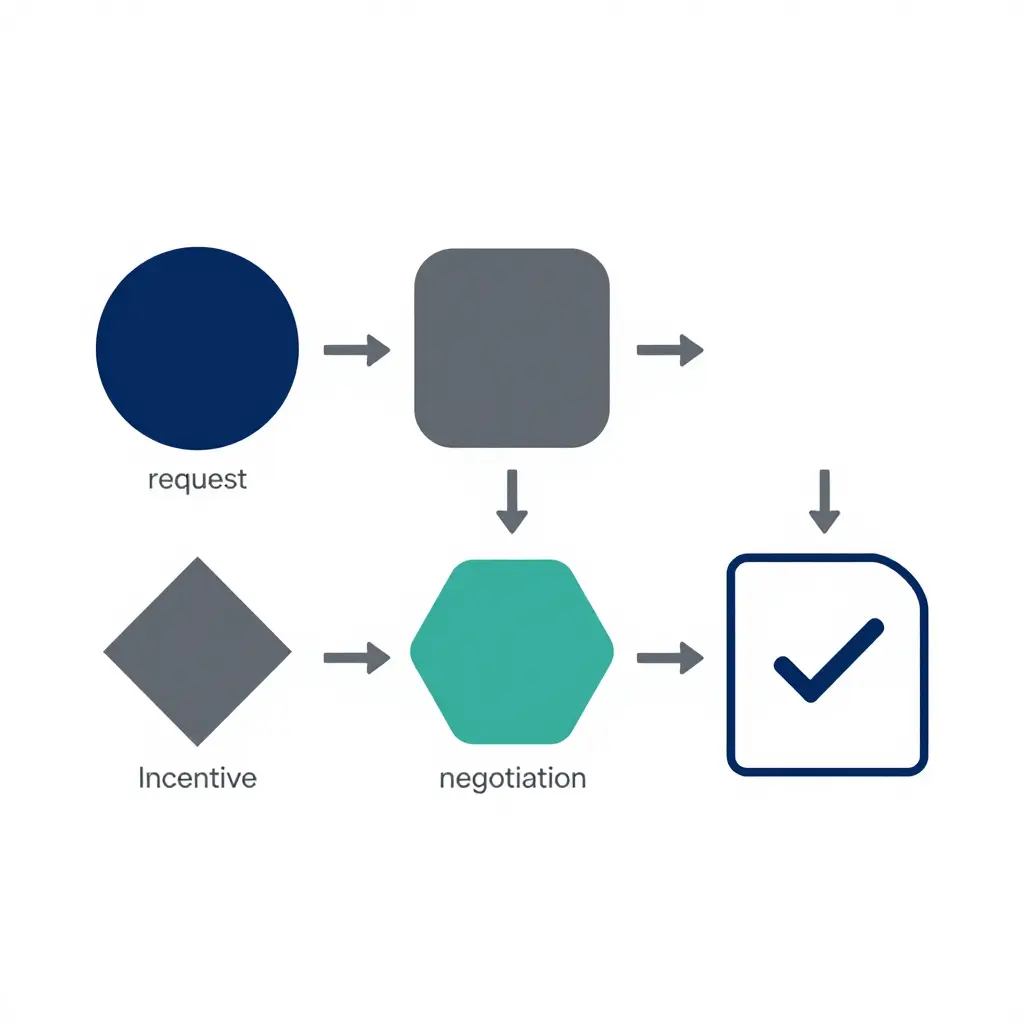
Process flow: request, configuration, incentive application, negotiation, and confirmation.
Regulatory and Market Factors That Shift Fleet Quotes
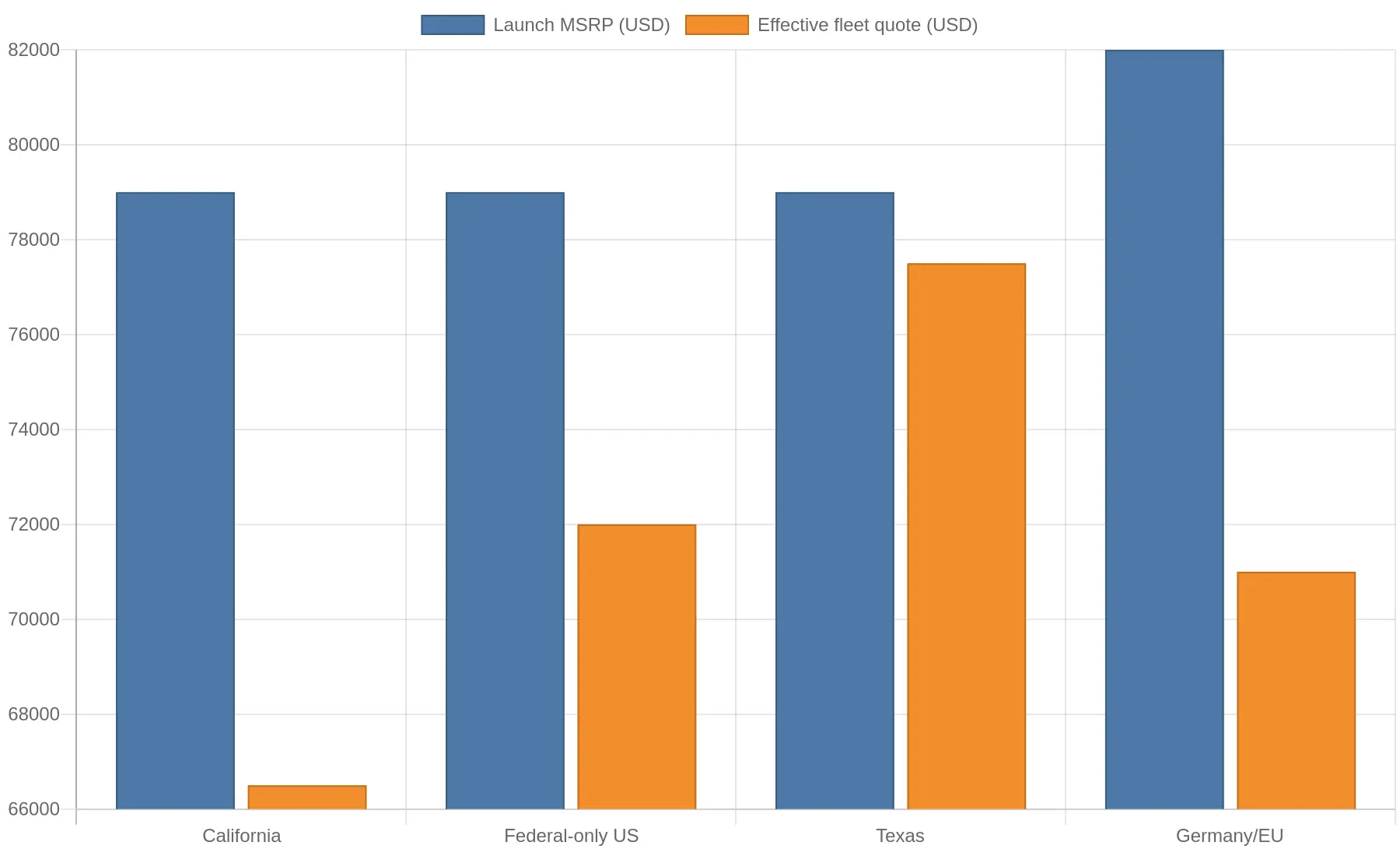
On a commercial electric truck, the launch MSRP is a headline figure, not the price a business pays. For fleet managers, the number that matters is the effective quote, and it moves with regulation, incentives, infrastructure readiness, and residual-value forecasts.
Compliance credits and incentives differ by jurisdiction
Regions bundle value in different ways. Some stack clean-fleet mandates with purchase vouchers, while others lean on tax credits or utility rebates. The same truck can carry a very different effective price depending on where it is registered and how it is operated.
| Jurisdiction | Primary regulatory lever | Typical effect on fleet quote |
|---|---|---|
| California | CARB Advanced Clean Fleets rules, HVIP vouchers | Lower upfront price, priority funding |
| Other US states | State grants, utility make-ready programs | Reduced charging capex |
| Federal (US) | 45W Commercial Clean Vehicle Credit | Up to $7,500 per qualifying vehicle |
| European Union | Toll waivers, weight allowances | Lower running cost, not sticker price |
| Low-incentive regions | None | Quote stays near MSRP |
Because these levers are not uniform, a Chevrolet Silverado EV price quoted in one state may not reflect what a buyer receives in another. Compliance-credit bundling lets some dealers discount while others hold firm, so identical trucks can land at different prices.
Charging infrastructure readiness
Where depot charging and public corridors are mature, quotes can assume higher utilization and lower energy cost, which supports more aggressive lease pricing. Where infrastructure lags, dealers often hold price or fold charging hardware into the deal, raising the effective cost.
Residual-value expectations
Residual value drives lease quotes more than sticker price. Battery durability, model-year churn, and incentive-dependent demand all shape forecasts. Trucks with predictable degradation and steady fleet utilization earn stronger residuals, which lowers monthly payments for operators.
Divergence from the launch MSRP is a feature of this market, not an error. Fleet managers who map incentives, infrastructure, and residual expectations get the truest price for a commercial electric truck.
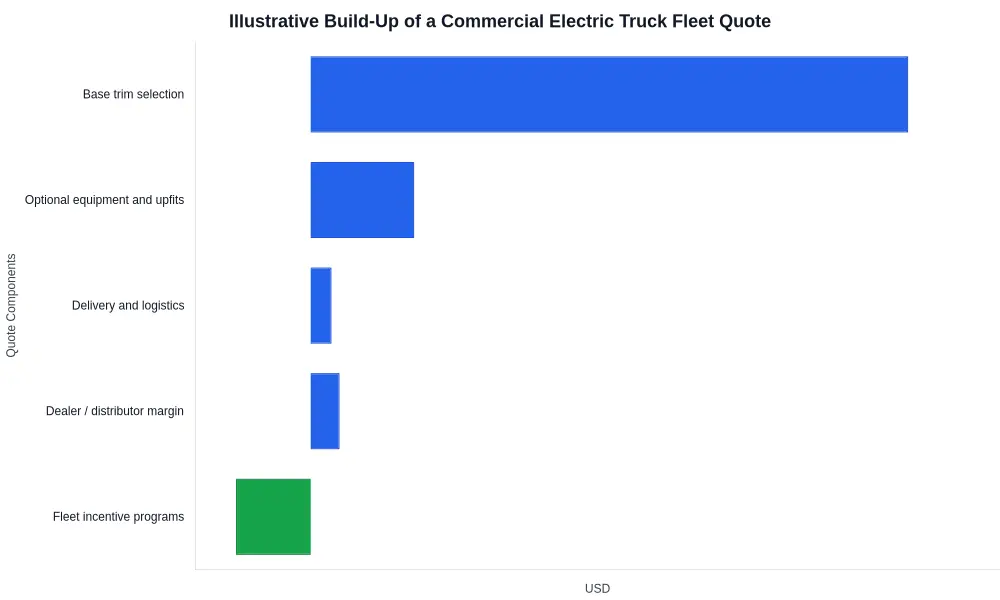
The chart below breaks down how each component contributes to a representative Silverado EV fleet quote, showing both the additive costs and the offsetting fleet incentive on a single zero-referenced scale.
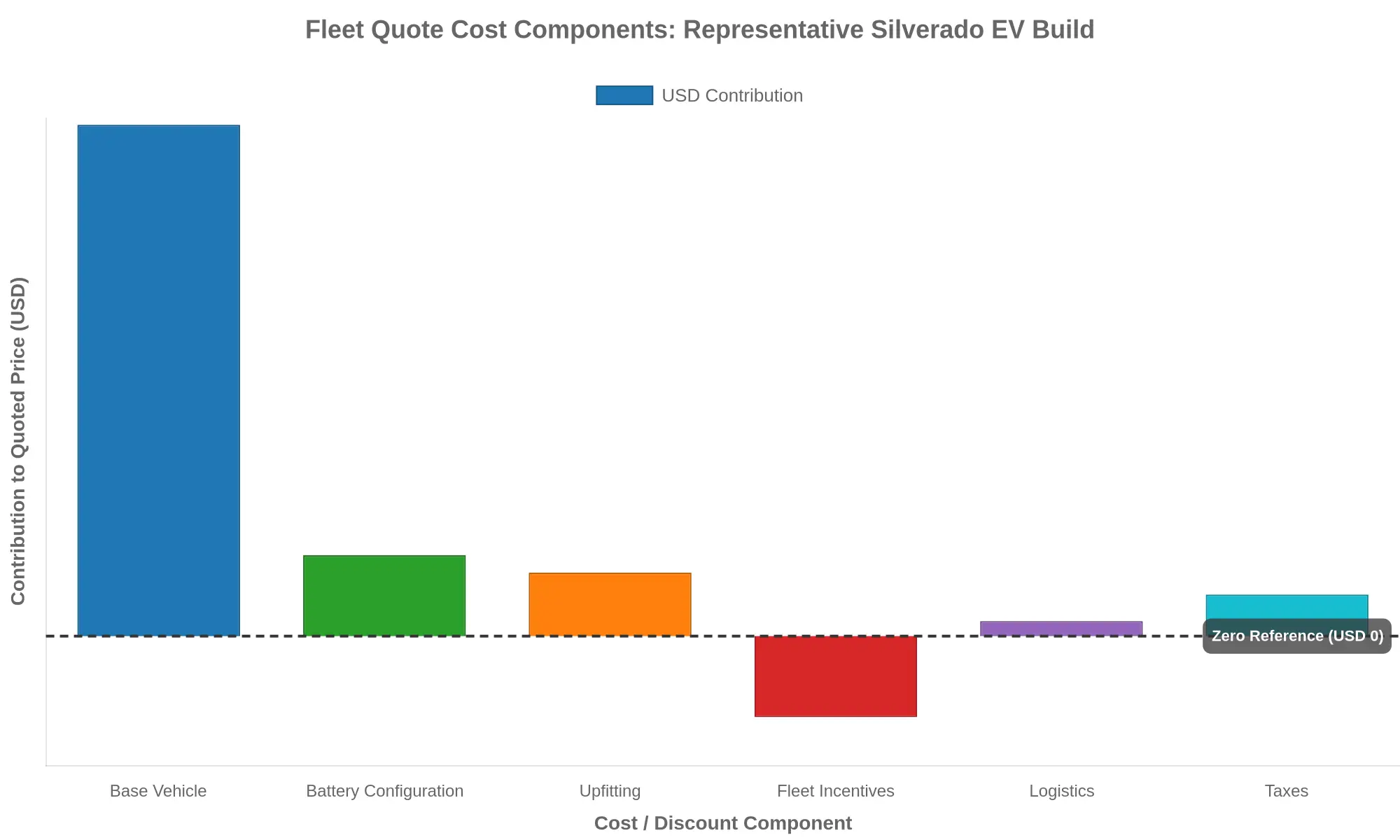
The spread between the launch MSRP and a signed fleet quote is rarely a single line item. It comes from how these components stack, how each one is weighted for a commercial buyer, and how that weighting moves the final figure (you can explore more on Chevrolet’s advertised electric truck pricing to see how those published numbers compare).
| Component | Example Contribution (USD) |
|---|---|
| Base Vehicle | 79,000 |
| Battery Configuration | 12,500 |
| Upfitting | 9,800 |
| Fleet Incentives | -12,500 |
| Logistics | 2,300 |
| Taxes | 6,400 |
Frequently Asked Questions About Chevrolet Silverado EV Fleet Pricing
Why does a fleet quote differ from the launch MSRP?
The launch MSRP is a consumer-facing reference figure tied to a specific trim and configuration. A fleet quote is built from a different foundation. It reflects the exact order code, trim, battery pack, and options your operation selects, plus fleet-only program eligibility, delivery and destination charges, and any commercial upfit coordination. Consequently, the Chevrolet Silverado EV price you receive in a fleet quote will rarely match the headline launch number, because the two figures describe different trucks under different commercial terms. To see how pricing is structured across models, review our guide to the Chevrolet Silverado EV price.
Is fleet pricing negotiable?
Fleet pricing is structured rather than haggled. Manufacturers publish fleet allowance programs, and dealers apply them according to volume, order timing, and account status. There is limited room to negotiate the base price, but there is meaningful room to negotiate total cost of ownership through allocation, delivery timing, and program stacking. Procurement teams should treat the quote as a configurable document, not a fixed sticker.
How do volume commitments affect the quote?
Volume commitments are one of the strongest levers on any fleet quote. Committing to a defined number of units, often across a set ordering window, typically unlocks tiered fleet allowances, priority allocation, and reduced per-unit pricing. Smaller commitments receive standard fleet pricing with fewer incentives. Buyers should model the break points carefully, because overcommitting to volume that exceeds operational need can erase the savings.
Is upfitting included in the quoted price?
Generally, no. The quoted vehicle price usually covers the chassis and factory options only. Upfitting, including service bodies, ladder racks, telematics, power take-off systems, and auxiliary power units, is quoted separately by the upfitter. Fleet buyers should always request an itemized quote that separates OEM pricing from upfit and integration costs.
How do incentives change over the model year?
Incentives are time-bound and typically follow the model year cycle. Early in a model year, programs emphasize launch allocation and are conservative. Mid-year, manufacturers often introduce stronger allowances to sustain delivery targets. By late model year, clearing inventory can produce the deepest discounts, but availability tightens. The effective Chevrolet Silverado EV price therefore shifts several times across a single model year.
Does the quoted price include destination and delivery fees?
Destination and delivery charges are almost always listed separately from the vehicle base price. These fees vary by region and can materially change the delivered cost. Always confirm whether a quote is priced at the factory gate or delivered to your location.
Key takeaway
A fleet quote is a structured commercial document built from configuration, volume, timing, and program eligibility. Comparing it directly to a launch MSRP without adjusting for those variables will always produce a misleading result.
Strategic Takeaways for Fleet Managers
Across every layer of this analysis, one pattern holds: there is no single “Chevrolet Silverado EV price.” The launch MSRP is a retail benchmark, not a commercial contract. Fleet quotes diverge from it because they price a configured asset, not a model name. Battery pack capacity, trim, wheelbase, GVWR class, chassis or box configuration, upfit readiness, and delivery geography each shift the number independently. Layer on volume commitments, commercial incentive programs, dealer allocation practices, documentation fees, and the timing of post-sale rebates, and a legitimate quote can land tens of thousands of dollars away from the advertised MSRP while remaining fully consistent with underlying cost structures.
For anyone building a procurement file, the discipline is straightforward: treat the MSRP as a reference point, then verify the variables that actually determine what you will pay, what you will receive, and when you will receive it. The table below consolidates the items worth confirming in writing before any purchase order is signed.
| Quote Variable | Why It Moves the Number | What to Confirm in Writing |
|---|---|---|
| Battery pack and range | Larger packs raise base cost and payload trade-offs | Usable kWh, EPA or certified range, payload rating |
| Commercial vs. retail program | Fleet incentives, allotments, and rebate timing differ | Program name, eligibility, payment date |
| Configuration and body | Trim, wheelbase, box, chassis, and upfit interfaces | Build sheet, upfit compatibility, lead time |
| Destination and logistics | Freight, port, and regional delivery surcharges | Delivered price, not FOB price |
| Fees and add-ons | Doc, prep, and dealer-installed equipment | Itemized fee schedule |
| Charging and infrastructure | Depot hardware, load upgrades, installation | Cost per vehicle, ownership of hardware |
| Warranty and service terms | Battery, drivetrain, and depot service coverage | Term, mileage, commercial-use exclusions |
Evaluating total commercial value means moving past the headline price entirely. The defensible model totals acquisition cost, energy cost per mile, depot charging infrastructure, scheduled maintenance, insurance, downtime exposure, driver retraining, and projected residual value at the end of your holding period. A quote that is $12,000 higher on paper can be the cheaper asset over six years if it carries a stronger battery warranty, requires less shop time, and retains better resale value. Conversely, the lowest bid frequently hides infrastructure costs and service gaps that surface in year two.
Partners who need non-standard builds, alternative body configurations, or coordinated cross-border delivery often find that domestic dealer channels cannot accommodate the specification as written. Suppliers such as EV Special Trucks, through evspecialtrucks.com, support custom configurations and full-set export solutions for fleet partners, which shortens the path from specification to delivered unit. Buyers comparing programs should also review how Chevrolet positions electric truck pricing across commercial channels.
The forward-looking reality is structural rather than speculative: as battery costs stabilize, commercial incentives normalize, and charging infrastructure matures, the gap between launch MSRP and executed fleet pricing will narrow, but it will not disappear. Fleet decisions made on verified quote variables and total cost of ownership will continue to outperform decisions made on sticker price alone.