

Introduction
An electric APU that passes a 30-minute daytime bench test can still be dead by sunrise. The pattern shows up in owner-operator cabs, fleet yards, and aftermarket installs: the unit powers up cleanly, holds steady voltage, and cools the sleeper under light daytime load. Then, a few hours into an overnight idle, it trips offline, browns out the cab, or quietly drains the battery bank.
The cause is almost never the compressor, the control board, or the battery chemistry. In most of these field failures it is an undersized DC converter. Short daytime tests pull low, intermittent current. An overnight idle draws something else entirely: the HVAC compressor, condenser fans, inverter, and 12-volt house circuits running near-continuously for six to ten hours. A converter sized for peak test conditions rather than sustained thermal and current limits overheats, folds back its output, and drops the whole system offline exactly when the driver needs it most.
This guide is written for semi truck owners and owner-operators, heavy-duty/Class 8 users, fleet managers, procurement and sourcing managers importing electric APU hardware from China, and heavy-duty technicians and engineers. It explains the engineering failure mode behind overnight idle shutdowns, shows how to calculate true continuous load, defines the converter specifications worth demanding on a datasheet, and details how to bench-test a unit before a fleet commits to it.
Later sections cover the electrical difference between a daytime test and a real overnight cycle, the converter sizing math, thermal derating, battery-bank interaction, and a sourcing checklist for verifying converter capacity with Chinese suppliers of electric APU units built for semi trucks.
The Overnight Idle Runtime Failure Mode, Defined
Overnight idle runtime is the number of hours an APU can sustain hotel loads – HVAC, cabin accessories, and house-battery charging – with the truck engine off and the driver asleep. That figure depends mostly on how the DC converter manages continuous power conversion between the high-voltage APU battery and the 12V/24V cabin bus. When the converter is undersized, runtime does not shrink a little; it collapses. Sourcing managers evaluating electric APU systems for semi trucks should rank the converter’s thermal rating above its peak output.
Short-Cycle Operation: The Masked Problem
In short, intermittent use – a 30-minute break, a quick cab cool-down – the system looks healthy. The DC converter runs a duty cycle of perhaps 20-40%, so heat from conversion losses dissipates between load bursts. Case temperatures stay low, conversion efficiency looks high, and the unit delivers its rated output without complaint. Many factory sample validations run exactly this short-cycle pattern, which is how a defective unit passes incoming inspection and still fails in the field.
Prolonged Overnight Idle: Where the DC Converter Fails
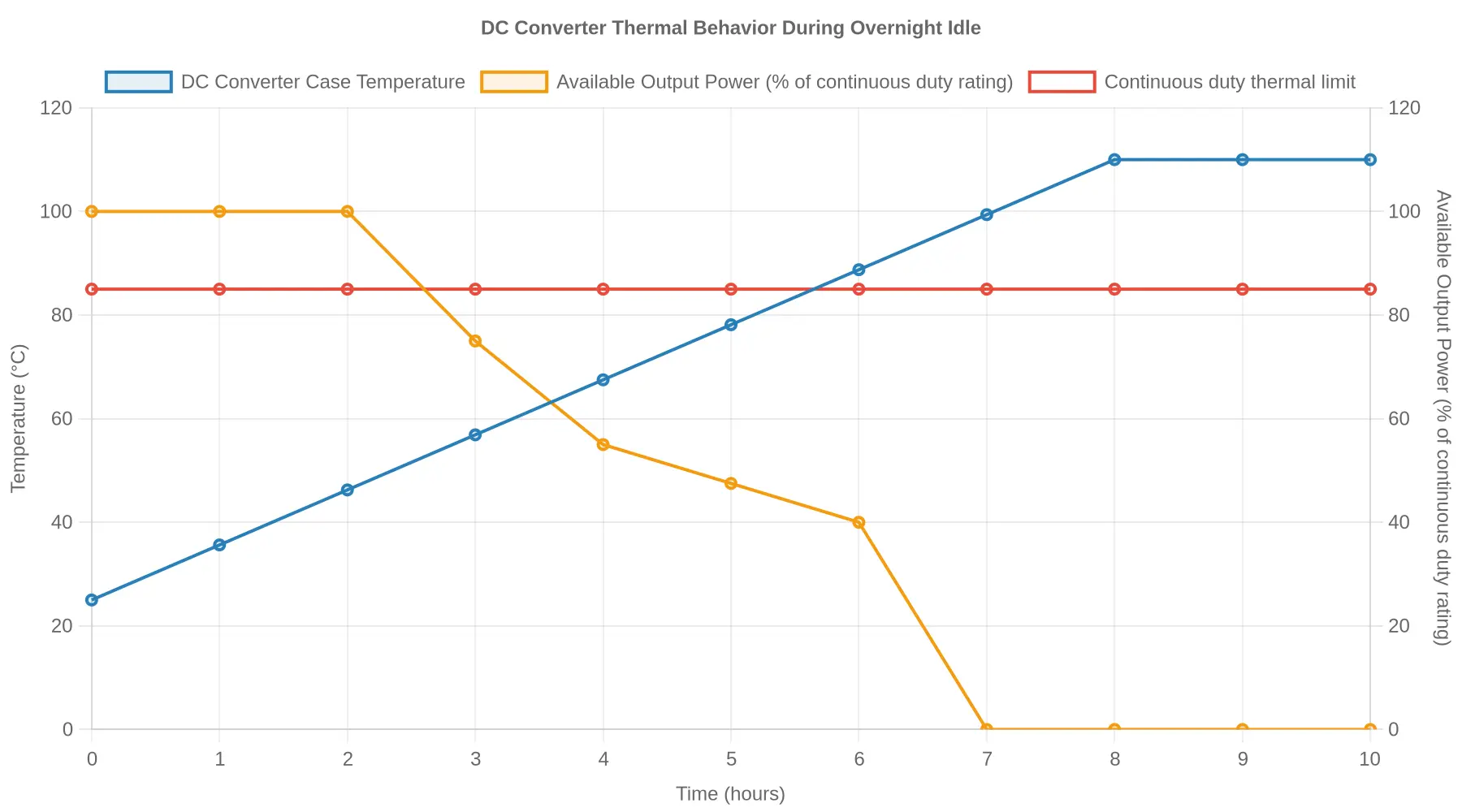
Overnight is a different regime. The HVAC compressor, cabin lighting, inverters, phone chargers, and a charging load on the house battery together form an uninterrupted, near-continuous demand that can run for 8-10 hours. The DC converter is now pushed to its true continuous duty rating. If that rating was copied from a peak number rather than a sustained one, it is exceeded, and heat accumulates faster than the heatsink can reject it.
As internal temperature climbs, thermal derating engages. The converter throttles its output on purpose to protect its semiconductors, cutting available power to the cabin. Once the case crosses the continuous duty thermal limit, the unit shuts down entirely to avoid damage.
Why Runtime Collapses
The result reinforces itself. Derated output starves the HVAC and battery charger, so a run that should last all night ends after three or four hours. Conversion efficiency also falls at high temperature, dissipating still more energy as heat. The advertised overnight idle runtime was measured on a short duty cycle; it was never a figure for a genuine overnight idle.
The DC Converter: The Quiet Component That Decides Whether Your APU Survives the Night
Every electric APU for semi trucks depends on one unglamorous but decisive part: the DC-to-DC converter. It bridges the truck’s high-voltage traction battery and the low-voltage loads that keep a driver comfortable and compliant through a long idle.
What the DC converter actually does
- Voltage conversion. It steps high-voltage pack power (often 400-800 V DC) down to the 12 V or 24 V rail that feeds cab climate fans, bunk HVAC, inverters, lighting, and control electronics.
- Current supply. It must deliver enough amperage to run all connected loads at once, not one at a time.
- Regulation. It holds output voltage steady even as input voltage sags and demand fluctuates.
- Thermal management. Switching losses produce heat, so the converter leans on heatsinking and often active cooling to stay inside its temperature limits.
Specifying these loads correctly during build-out is where planning pays off; see this guide to managing 12V loads during upfitting.
| Function | What it protects | Failure symptom when marginal |
|---|---|---|
| Voltage conversion | Cabin and bunk electronics | Brownouts, resets, inverter faults |
| Current supply | Simultaneous load operation | Voltage sag under combined load |
| Regulation | Stable output | Flicker, control glitches |
| Thermal management | Converter longevity | Derating and thermal shutdown |
The real problem: peak ratings versus continuous load
An undersized DC converter usually gets onto a spec sheet because someone sized it against a peak or surge figure rather than its rated continuous current. A 30-second surge number looks generous on paper and collapses under a steady, multi-hour draw. The converter that runs a five-minute demo is not the converter that powers an APU from dusk to dawn.
What happens over an 8-12 hour idle period
This is where the failure mode shows itself. Above a continuous load of roughly 80 percent of rating, efficiency begins to drop, so more input power turns into waste heat instead of usable output. The chart below shows the classic shape of that curve.
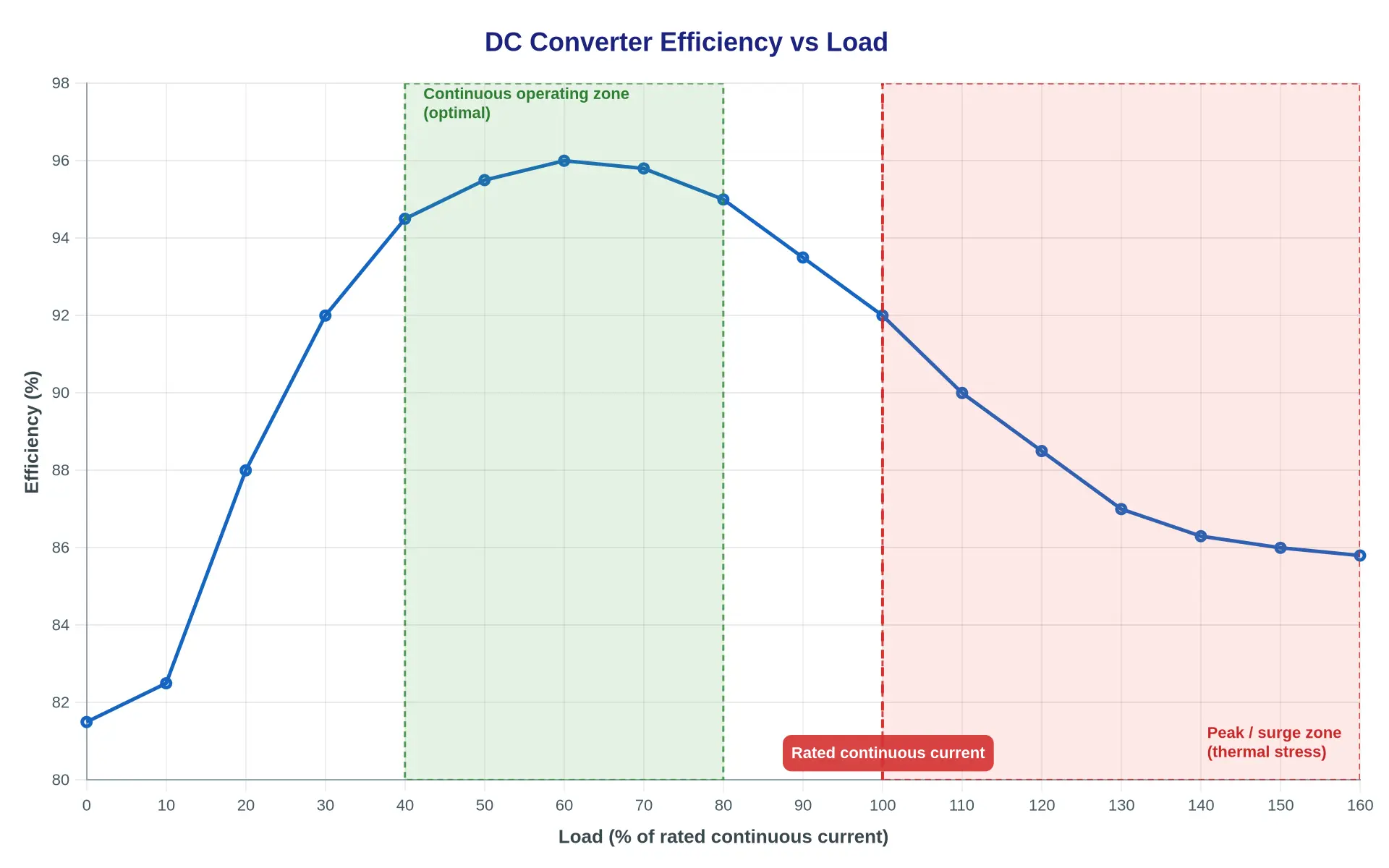
Once heat builds faster than the heatsink can dissipate it, a chain reaction starts:
- Efficiency falls, so the converter draws more current to hold output.
- Junction temperatures climb, pushing the unit toward its thermal ceiling.
- Protection kicks in, derating output just when demand peaks.
- Thermal shutdown trips, killing the APU overnight.
The driver wakes to a dead APU and a no-start battery. For buyers importing from overseas, the rule is simple: confirm the continuous current rating against your worst-case 12-hour load, not the surge number. That one specification decision separates a reliable system from a recurring failure.
Why Converter Sizing Decides Overnight Idle Runtime
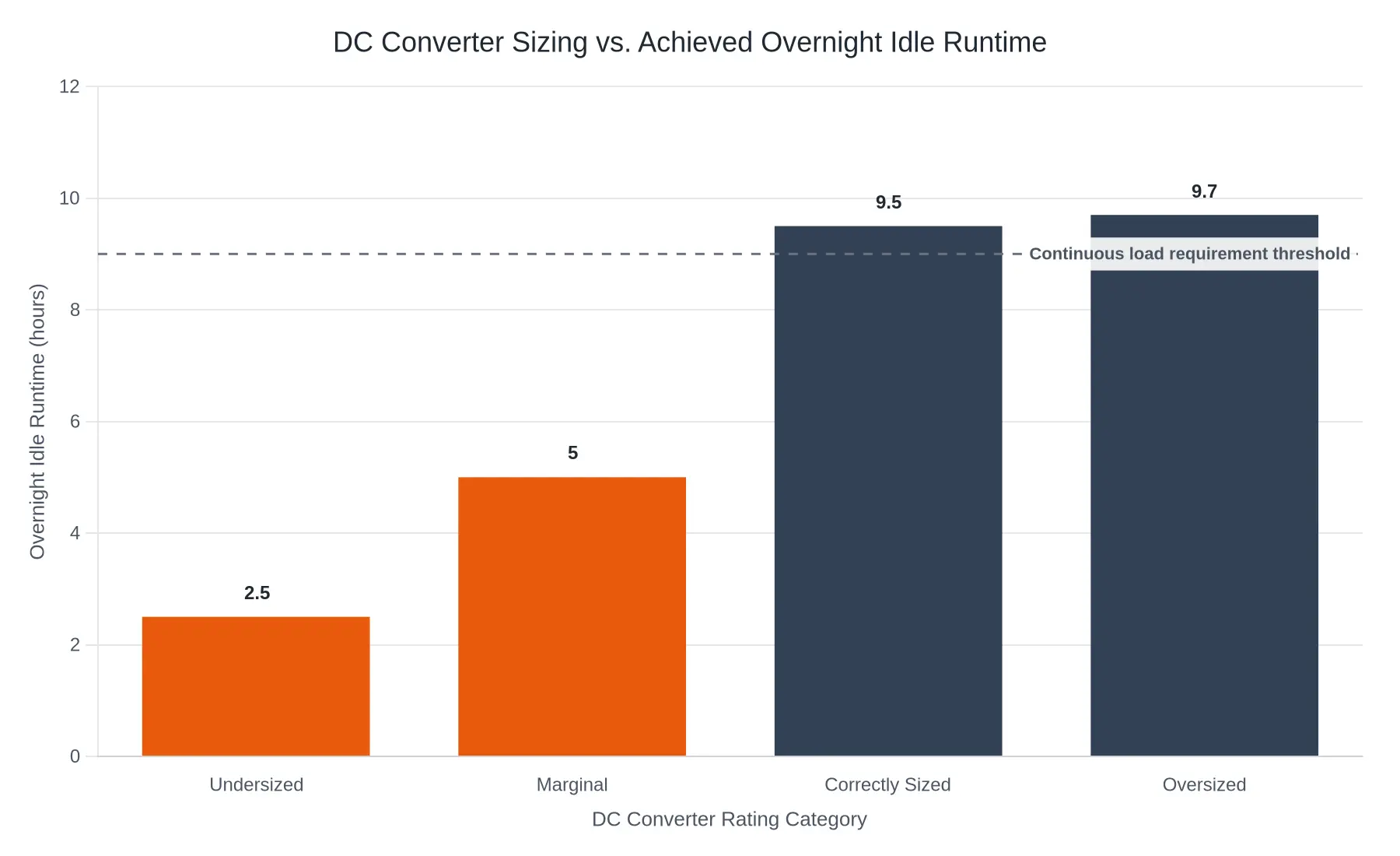
When an electric APU from a China factory “works on the bench” but dies at the truck stop, this chart is the first thing to check. It maps DC converter rating category against the overnight idle runtime actually achieved. The drop is not gradual – runtime collapses the moment the converter falls below the continuous load requirement.
Runtime by Converter Rating Category
| Converter Rating Category | Overnight Idle Runtime (hours) | Operational Verdict |
|---|---|---|
| Undersized | 2.5 | Fails before midnight |
| Marginal | 5.0 | Fails mid-sleep cycle |
| Correctly Sized | 9.5 | Meets overnight requirement |
| Oversized | 9.7 | Meets requirement, added mass and cost |
Why the Curve Is Asymmetric
Oversizing the converter buys 0.2 extra hours; undersizing it costs seven. Runtime follows the continuous rating under sustained thermal load, not the peak rating on a specification sheet. A converter marketed as “1500W” may deliver that figure only in a burst window. Held continuously at the APU’s overnight draw, it derates, overheats, or trips protection, and runtime falls off a cliff rather than declining gradually.
For anyone specifying or sourcing these systems from overseas, the practical rule is to match the converter’s continuous rating to the total sustained overnight load plus headroom, and to verify that rating with a thermal soak test rather than a datasheet. When a sample passes a five-minute load bank but fails a nine-hour idle run, the problem is almost always the converter, not the battery or the inverter.
The same sizing discipline applies to other 12V-load retrofits on work trucks. Benchmarking against real-world electric work truck electrical loads before committing to a converter spec saves far more money than debating cell chemistry.
Why China Factory Samples Ship with Undersized DC Converters
An undersized DC converter is rarely a random defect. It follows predictably from how sample units are designed, sourced, and tested long before they reach a North American fleet. Knowing the causes helps fleet managers and importers ask sharper questions during procurement.
Samples Are Engineered for the Demo, Not the Duty Cycle
Most China factory samples are built as sales tools. The objective is to power the unit through a short walkthrough, not to sustain a ten-hour overnight idle. Engineers select a DC converter that meets peak demo demand comfortably while ignoring continuous thermal load, conversion-efficiency losses, and derating at high ambient temperatures.
Cost-Driven Component Substitution
Once a preliminary bill of materials is approved, suppliers routinely swap the specified converter for a lower-cost equivalent. A unit rated for continuous output is replaced by one rated only at peak, frequently from an unlisted second-tier vendor. On paper the wattage looks identical; under sustained load the replacement overheats and folds back its output.
Optimistic Spec Sheets
Spec sheets for an electric APU for semi trucks often quote converter capacity at 25 degrees C with ideal airflow. Real installations sit behind a sleeper panel where airflow is poor and temperatures climb. The advertised figure is technically true but operationally meaningless for continuous duty.
Testing Only Under Light Daytime Loads
Factory validation frequently occurs during daytime hours with only instrumentation and lighting active. The heavy loads – sleeper HVAC, refrigerator, and inverter – are never run at full draw for more than a few minutes. The overnight load profile that matters most is simply never exercised.
Mismatched Inverter/Converter Pairing
When the inverter and DC converter are sourced independently, their duty ratings and control logic may not align. A converter sized for a lower inverter surge can brown out during compressor startup, forcing repeated restarts that drain the auxiliary battery bank.
What This Means for Fleet Managers and Importers
The consequences are concrete. A DC converter that is 30 to 40 percent undersized for overnight duty will fail during the first cold-weather idle test, stranding drivers and creating warranty disputes across an ocean. Importers who source electric APU systems from China factories take on that risk whenever they validate samples on the bench alone. Demand continuous-duty ratings, request third-party load testing at real ambient temperatures, and verify the converter and inverter as a matched pair before committing to volume.
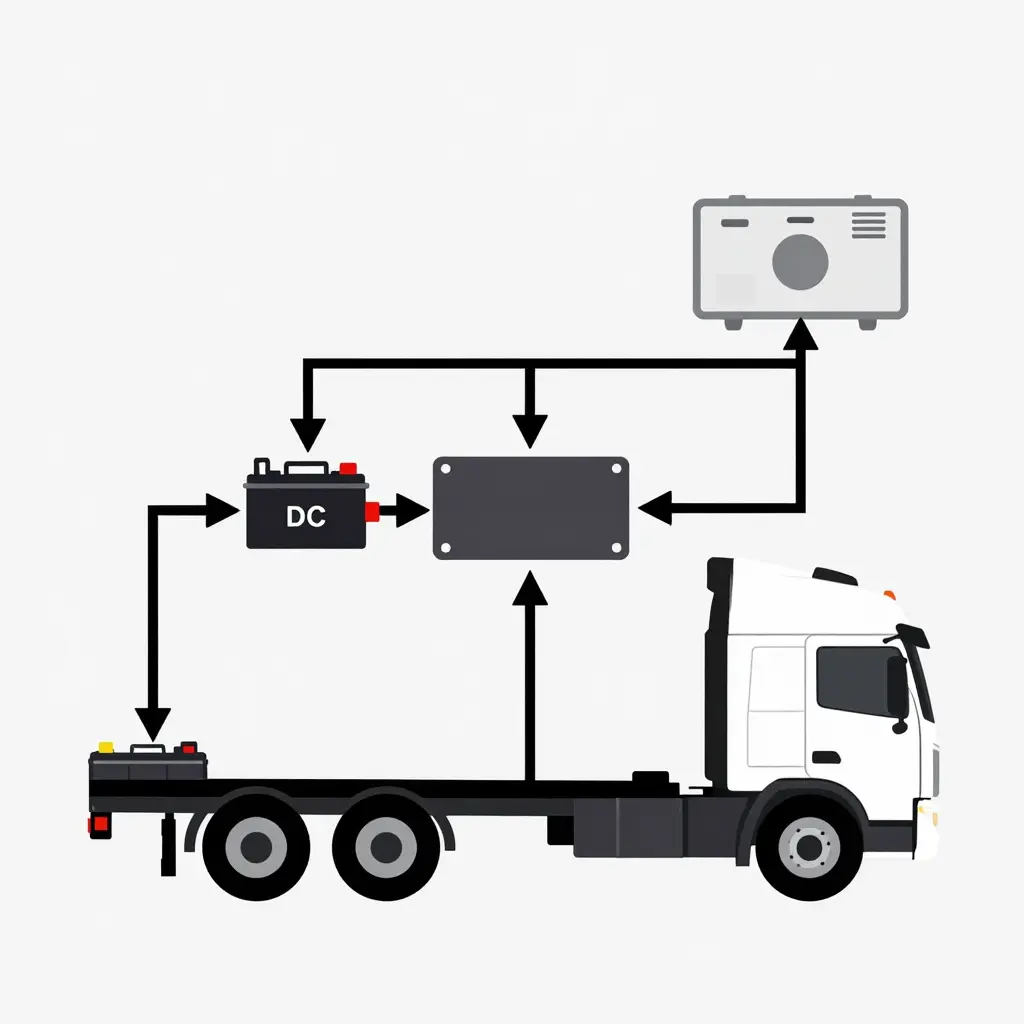
Schematic power flow for an electric APU: the battery pack feeds current through the DC converter, inverter/controller, and out to the HVAC and cabin accessory loads. The undersized DC converter is the highlighted bottleneck in the chain.
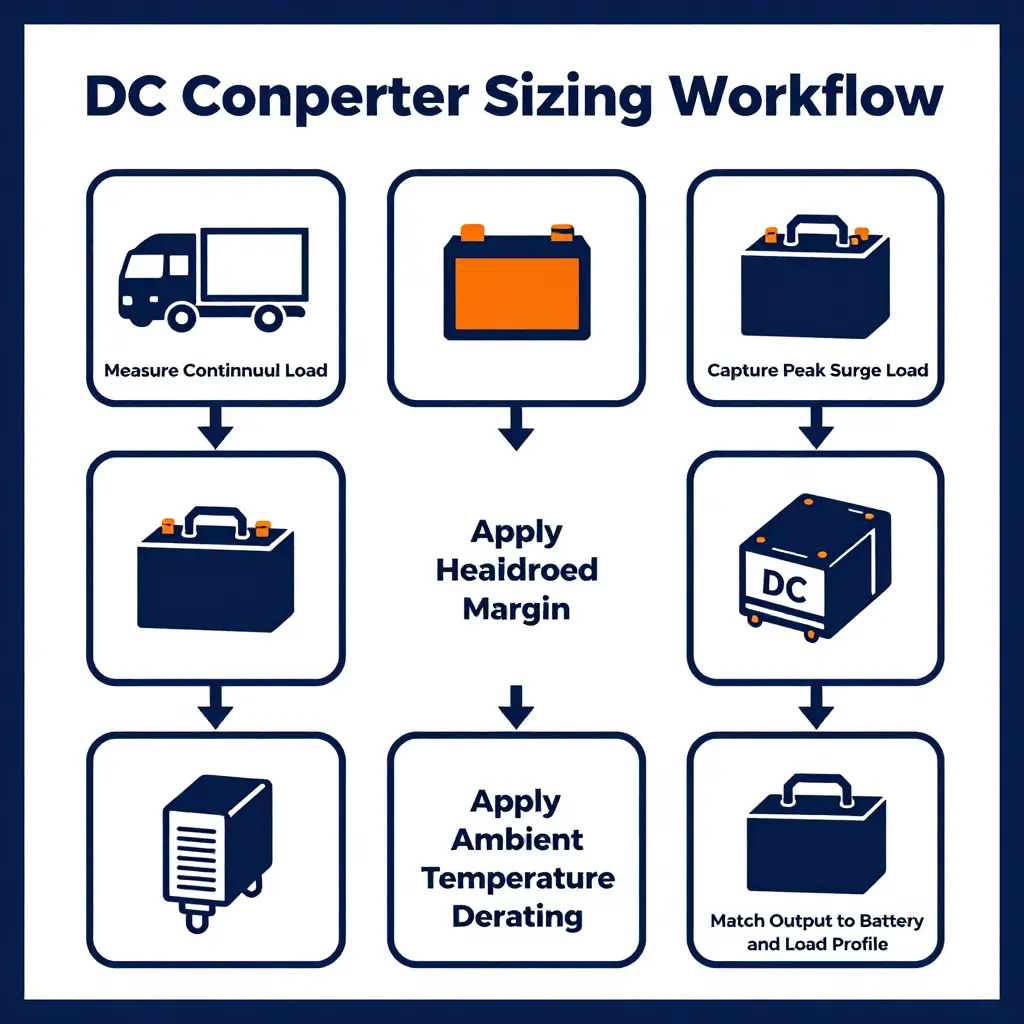
DC Converter Sizing Methodology for Electric APU Systems
Sizing the DC converter correctly is the difference between an electric APU that idles all night and one that dies at 2 a.m. Pair an electric APU for semi trucks with an undersized converter and it cannot sustain overnight cabin loads; runtime collapses. The six steps below specify the right component.
Step 1: Establish the Continuous Load
List every load the APU serves without interruption – HVAC blower, refrigeration, interior lighting, electronics, and inverter overhead. Sum their steady-state current draw at the nominal DC bus voltage. That total sets the floor for the continuous power rating.
Step 2: Capture the Peak Surge Load
Compressor and fan motors pull inrush current two to three times their running draw for several seconds on startup. Record this transient peak; a converter that ignores it will trip on every compressor cycle.
Step 3: Apply a Headroom Margin
Size the converter’s continuous power rating 20-30% above measured continuous demand. That headroom absorbs load creep, aging, and unexpected accessory additions without forcing the unit to run at its limit.
Step 4: Apply Efficiency Derating
DC converters typically run 88-94% efficient. Divide your load by the conversion efficiency to find the true input demand. An efficiency derating of even 10% can push a “just enough” converter into overload.
Step 5: Apply Ambient Temperature Derating
Output capacity falls roughly 2-3% per degree Celsius above 40°C/104°F. Summer sleepers and engine-compartment mounts run hot, so ambient temperature derating is mandatory, not optional.
Step 6: Match Output to the Battery and Load Profile
Confirm the converter’s output voltage window aligns with the battery bank’s charge profile and that its current matches the overnight duty cycle. Oversizing wastes energy; undersizing fails.
| Sizing Factor | Typical Value | Action |
|---|---|---|
| Continuous power rating | Measured steady load | Baseline |
| Headroom margin | +20% to +30% | Add to baseline |
| Efficiency derating | 88% to 94% | Divide load by efficiency |
| Ambient temperature derating | -2% to -3% per °C over 40°C | Multiply by derate factor |
Procurement managers should demand a datasheet that states derated output at real operating temperatures, not a headline number. For buyers comparing electric APU for semi trucks sourced from China, verifying these derating figures prevents the overnight runtime failures that plague undersized samples.
Undersized vs. Correctly Sized DC Converter: Spec-by-Spec
The fastest way to spot a future runtime failure is to lay the factory sample spec sheet next to a real duty-rated unit. The table below contrasts a typical undersized DC converter shipped in an entry-level electric APU for semi trucks from China against a unit genuinely sized for continuous overnight duty. Every gap traces back to the same root cause: a passive bench figure quoted in place of a continuous-duty rating.
| Metric | Undersized Unit (Factory Sample) | Correctly Sized Unit | Technical Note |
|---|---|---|---|
| Rated continuous power | 1,000 W | 3,000 W | Factory samples quote a 25 C bench figure; the DC converter must hold its rating at sustained cabin temperature. |
| Peak power | 1,500 W (30 s) | 4,500 W (60 s) | Short surge windows collapse when the AC compressor and inverter ramp together. |
| Continuous current (12 V output) | 80 A | 250 A | Sustained output current, not peak, is what sizes a DC converter for combined hotel loads. |
| Efficiency | 86% at 30% load, sagging to ~80% at full load | 93% flat across 20-100% load | A load curve that only peaks at light load wastes energy and adds heat to the DC converter. |
| Thermal derating threshold | 40 C (104 F) | 55 C (131 F) | Early derating throttles output exactly when the cab is hottest and demand is highest. |
| Expected overnight idle runtime | 4-5 hours | 10-12 hours | The undersized DC converter overheats and trips, ending overnight idle well before dawn. |
| Tropical / cold ambient suitability | Poor (overheats in tropics, weak cold-crank in winter) | Good (stable from -30 C to +55 C) | A wide-temperature DC converter uses derating-aware components and active thermal management. |
The two columns are not a minor spec difference: they represent a roughly 3x gap in usable continuous output. That gap is why a unit that passes a 20-minute factory demo can fall over at hour five of a real overnight idle.
Worked Example: Sizing an Electric APU’s Overnight Load
Here is a repeatable method you can run against any China factory sample before you commit to a container. The example is an 8-hour overnight rest in a sleeper cab at 20 degrees F, a worst-case scenario that forces the cabin HVAC to run continuously.
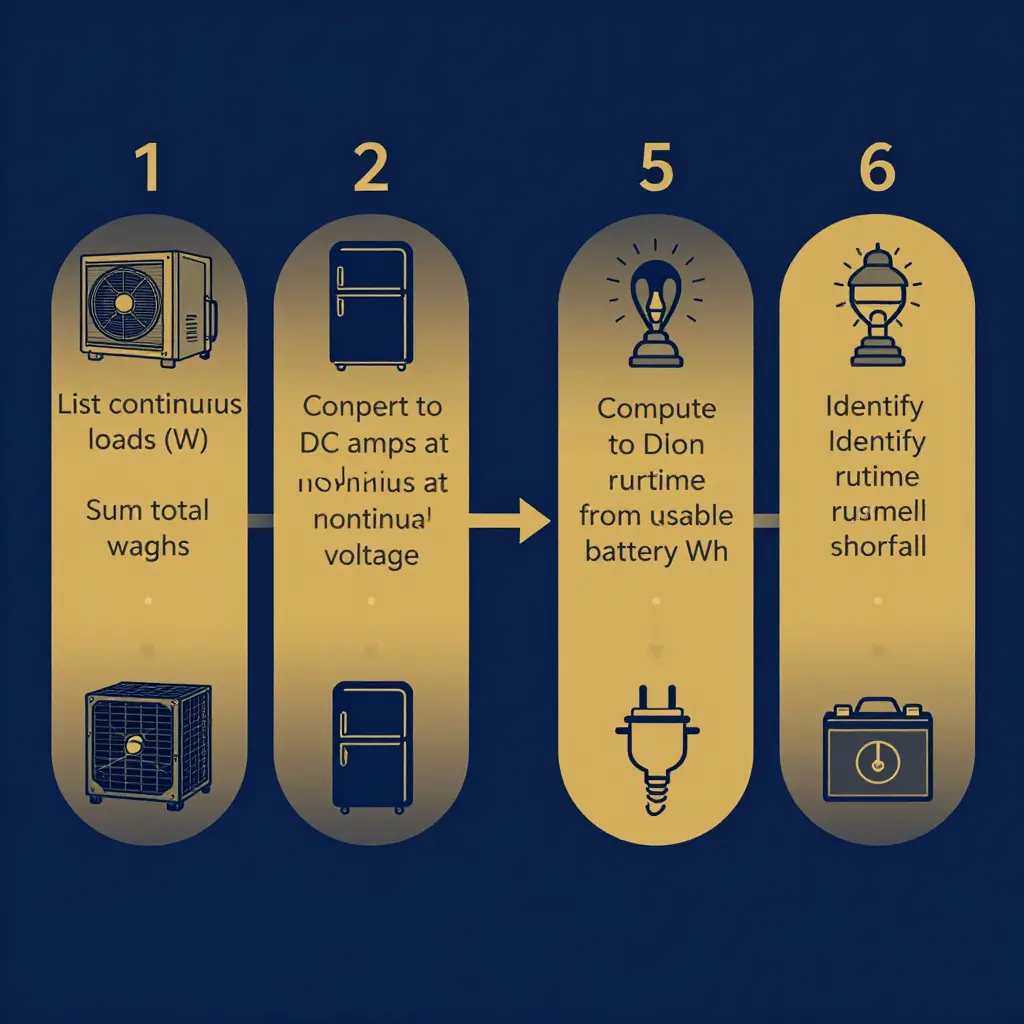
Step 1: List the Continuous Loads
Start by naming every load that runs for the full duty cycle, not just the biggest one. Continuous does not mean constant – it means the load draws current across the entire window. For our example we assume a 12 V nominal bus and these sub-systems:
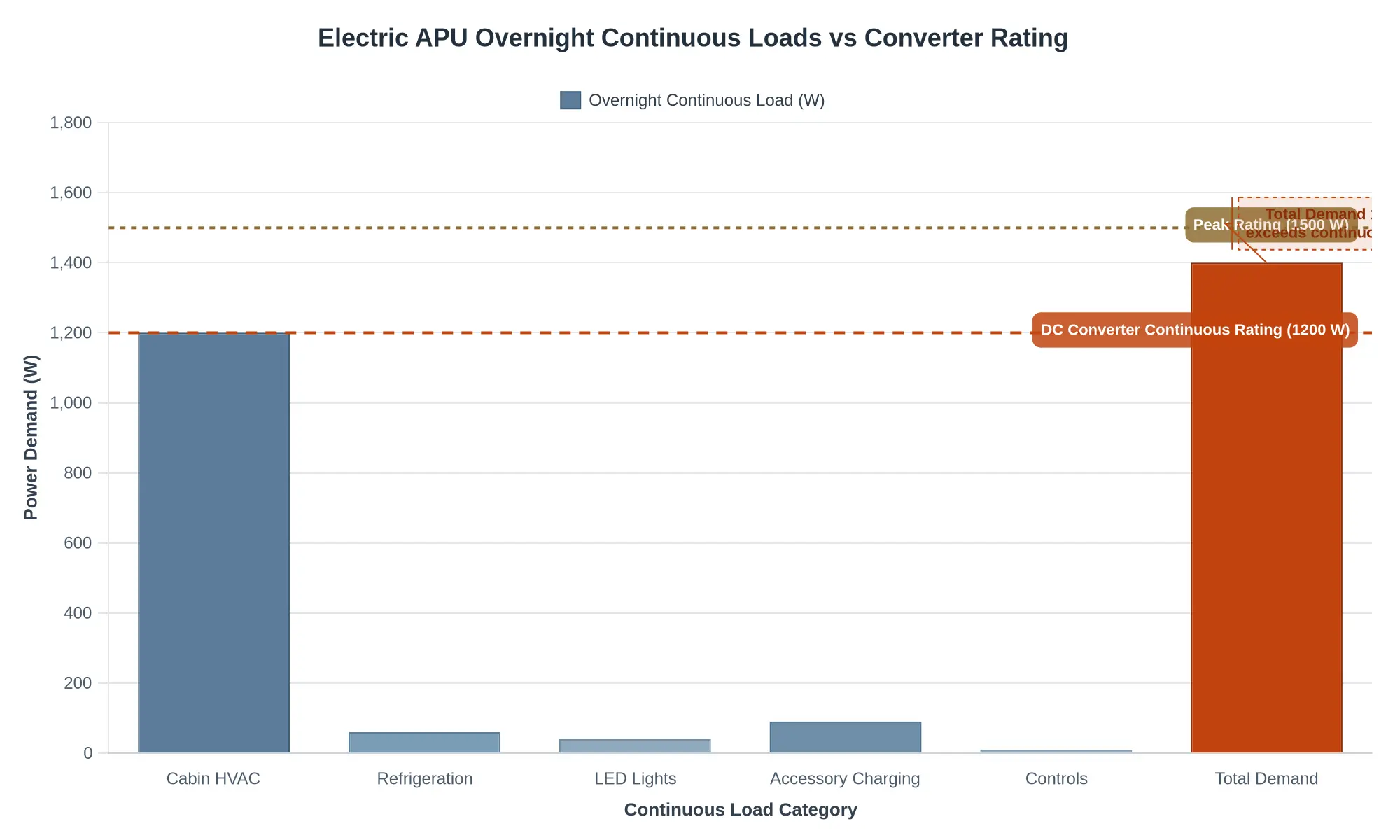
- Cabin HVAC (heat pump or resistance heat): 1,200 W
- Refrigeration (12 V compressor fridge, averaged over its duty cycle): 60 W
- LED lights (interior and marker): 40 W
- Accessory charging (inverter loads – laptop, phone, tools): 90 W
- Controller and monitor standby: 10 W
Step 2: Sum the Loads and Convert to Power Demand
Add every continuous figure to get total power demand:
| Sub-system | Continuous Load (W) | Current at 12 V (A) |
|---|---|---|
| Cabin HVAC | 1,200 | 100.0 |
| Refrigeration | 60 | 5.0 |
| LED lights | 40 | 3.3 |
| Accessory charging | 90 | 7.5 |
| Controller and monitor | 10 | 0.8 |
| Total demand | 1,400 | 116.7 |
Power demand is the sum of watts; DC current is watts divided by bus voltage (1,400 W / 12 V = 116.7 A). The converter must source that 116.7 A continuously.
Step 3: Compare Against the Converter’s Continuous Rating
Now read the converter datasheet. Our sample lists 1,200 W continuous (100 A) and 1,500 W peak for 30 seconds. The continuous load of 1,400 W sits 17 percent above the continuous rating, and the peak figure only buys 30 seconds – nowhere near an 8-hour sweep.
Step 4: Calculate Overnight Idle Runtime
Take usable battery energy and divide by demand. Assume a 600 Ah LiFePO4 bank at 12 V (7,200 Wh nominal) at 90 percent usable depth of discharge:
- Usable energy = 7,200 Wh x 0.90 = 6,480 Wh
- Ideal runtime = 6,480 Wh / 1,400 W = 4.6 hours
Against the 8-hour target, the ideal overnight idle runtime falls 3.4 hours short – about 42 percent. In practice it is worse, because the undersized DC converter throttles before the battery is even close to empty.
Step 5: Quantify the Shortfall From an Undersized DC Converter
A converter tasked with 116.7 A against a 100 A continuous rating begins thermal derating within 30 to 45 minutes. Output clips to roughly 900-1,000 W, so the HVAC compressor cycles off, cabin temperature drifts, and a load that was supposed to run all night now runs on a defective duty cycle. The battery never gets a clean discharge curve because the converter, not the cells, sets the ceiling. When you evaluate electric APU for semi trucks from China factories, size the converter continuous rating at 1.25x your summed continuous load – here that means at least 1,750 W continuous – and demand a thermal-derating curve, not just a peak number.
Your Repeatable Checklist
- List every continuous load in watts.
- Sum them; divide by bus voltage for continuous amps.
- Apply a 1.25x margin and compare to the converter’s continuous rating.
- Divide usable battery Wh by total demand for ideal runtime.
- Subtract from your overnight target to expose the real shortfall.
Run every China factory sample through these five steps before quoting, and the undersized DC converter problem is caught before it reaches your customer.
Why Temperature Extremes Expose an Undersized DC Converter
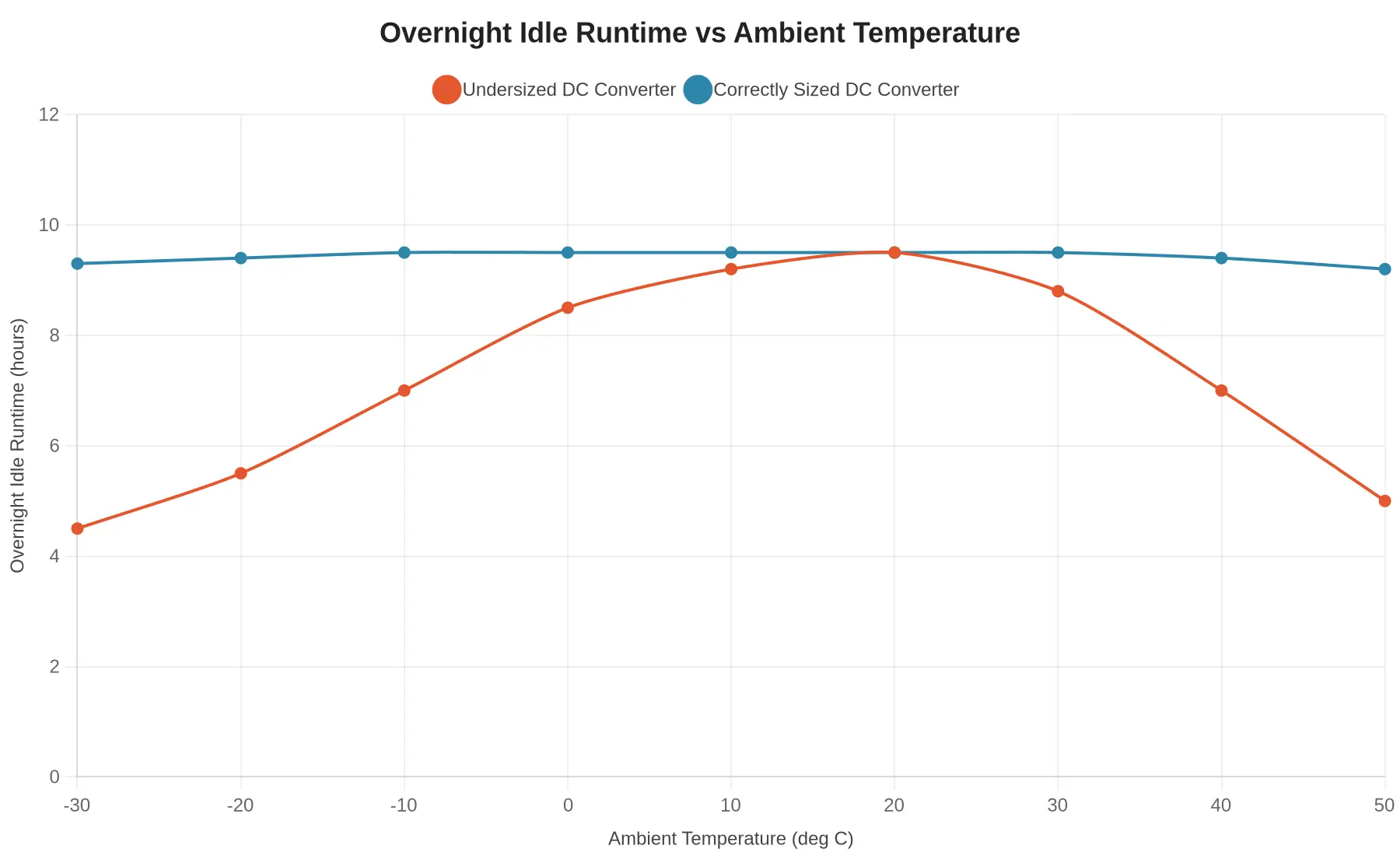
Sizing a DC converter is not a fair-weather exercise. The failure mode that sinks so many China factory APU samples rarely shows up on a mild 20°C test bench; it reveals itself at the edges of the operating envelope. The chart below plots achieved overnight idle runtime against ambient temperature for two otherwise identical electric APU systems. Both meet their nameplate continuous rating at 20°C. One is sized to the continuous load with no thermal headroom; the other is sized with margin. It is the no-headroom unit that proves undersized once derating applies, not the severely undersized converter from the sizing chart above, which fails even at room temperature.
Where the Two Systems Diverge
At a comfortable 20°C, both systems look nearly indistinguishable – the converter without headroom achieves about 9.5 hours, and so does the correctly sized unit. This is exactly why the problem slips through incoming inspection. The divergence appears only as ambient temperature moves toward either extreme:
- At -30°C: the no-headroom converter drops to roughly 4.5 hours, while the correctly sized unit holds near 9.3 hours. Cold-soaked battery chemistry, elevated viscosity, and reduced converter efficiency compound each other.
- At 50°C: the no-headroom converter falls to about 5.0 hours as thermal derating throttles its output, while the correctly sized unit stays stable around 9.2 hours.
The correctly sized converter traces a nearly flat line across the full range. The no-headroom unit traces a steep U-shape, sagging hard at both ends. That U-shape is the signature of thermal derating on a component that was never given enough headroom.
Why Headroom Keeps Runtime Flat
A DC converter that runs at or near 100% of its rated capacity has no margin to absorb the efficiency losses that arrive with temperature swings. When ambient heat or cold pushes internal junction temperatures up, the converter folds back its output, and overnight idle runtime collapses with it. Specifying the converter with genuine thermal headroom (typically derating to 60-70% of nameplate at worst-case ambient) is what keeps the runtime line flat instead of curving downward. Before committing to an import order, it pays to audit how a China-based factory specifies its DC converter against your real-world climate, not just its catalog rating.
Supplier Vetting Questions Before You Buy an Electric APU
When sourcing an electric APU for semi trucks from a China factory, the DC converter is precisely where glossy spec sheets and real-world overnight idle runtime tend to diverge. Ask these questions before you commit to volume orders.
-
What is the DC converter’s continuous versus peak power rating, and how long can it sustain peak output? A converter rated only by its peak figure will overheat and throttle during the hours-long, steady loads of overnight idle, collapsing your runtime exactly when drivers need it.
-
Can you provide thermal derating curves showing rated output at 25°C, 45°C, and 60°C ambient? Derating data reveals how much usable power genuinely remains inside a hot engine bay or a sun-baked cab roof.
-
Do you publish a full efficiency curve across the 20-80% load band, not just a single peak-efficiency headline number? Overnight idle operation runs at partial load, so efficiency at realistic duty points, not the marketing peak, determines true energy consumption.
-
Under exactly what test conditions were those efficiency and runtime figures measured? Without a defined ambient temperature, load profile, and measurement setup, specification numbers cannot be compared or independently verified.
-
What are the warranty terms specifically covering DC converter failure, and is converter burnout excluded as ‘misuse’? A warranty that carves out the component most likely to fail provides buyers with no meaningful protection.
-
Has the unit been validated in both cold-soak (-20°C and below) and high-heat (50°C+) climate testing? Extreme temperatures stress converter components and battery chemistry, exposing designs that only survive comfortable lab-bench conditions.
-
How does the BMS coordinate with the DC converter under sustained low-current loads? Poor coordination leads to premature low-voltage cutoff and the overnight idle runtime failures buyers repeatedly report.
-
Can we receive China factory samples for lab and in-cab overnight testing before a production order? Hands-on sample validation under your own duty cycle is the only reliable way to confirm the converter is correctly sized.
-
What is the converter’s MTBF or field failure rate, and can you supply references from existing fleet customers? Track-record data separates factories that engineer for durability from those that assemble to a price point.
-
Is the DC converter’s output curve matched to the APU’s total continuous load budget, including inverter, HVAC, and parasitic draw? An undersized converter that ignores total system demand will fail precisely when overnight comfort matters most.
For a deeper look at how these systems are built and specified, explore our guide to the electric APU for semi trucks factory in China.
Conclusion: The DC Converter Is the Real Runtime Constraint
The engineering takeaway is unambiguous. The overnight idle runtime of an electric APU for semi trucks is set by the continuous sizing of its DC converter, not by battery capacity or headline wattage. When that converter is an undersized DC converter, sustained hotel loads – bunk HVAC, inverters, and 12V accessories – drive it into thermal derating, output throttling, and eventual shutdown well before morning. This is exactly why so many China factory samples sail through a brief bench test yet collapse under a true eight-to-ten-hour idle cycle.
Specification Decision Framework
Use the sizing methodology, comparison table, and diagnostic checklist covered earlier as your screening sequence, and match the depth of verification to your role:
| Role | What you are protecting against | What you must verify before approval |
|---|---|---|
| Procurement manager | Spec-sheet inflation from sample vendors | Continuous (not peak) DC converter rating, published derating curve, thermal test data |
| Fleet operator | Midnight shutdowns and driver complaints | Documented overnight runtime at full hotel load, tested at the lowest expected ambient temperature |
| Technician / engineer | Margin erosion as accessories are added | Extra DC headroom above measured steady-state load, plus a repeatable bench-load procedure |
Three Non-Negotiable Checks
- Specify the converter by continuous rating, and hold measured steady-state draw at or below that figure – never at its peak.
- Require temperature-referenced runtime evidence, not room-temperature demonstrations.
- Reject any China factory samples that cannot supply a derating curve and a sustained-load thermal test.
For teams building this verification step into sourcing, the electric APU sourcing guide for China-built units details the documentation to demand.
The bottom line: an electric APU for semi trucks is only as dependable as its DC converter is continuous. Size it correctly, verify it under real overnight conditions, and it becomes a reliable fleet asset; get the converter sizing wrong, and no battery bank will save the night. Specify the continuous rating – and never trust a sample that has not proven it under sustained load.