
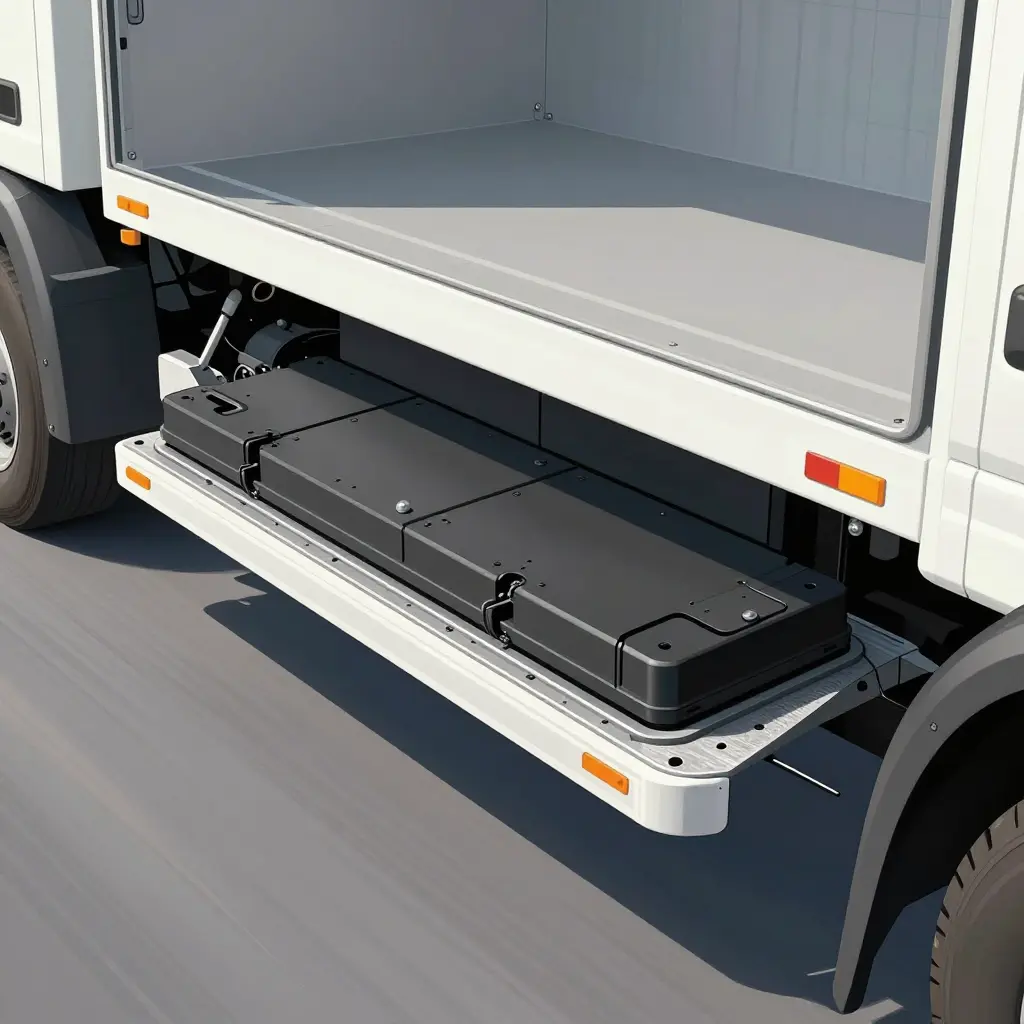
Electric truck running boards cannot reuse the mounting geometry of their diesel and gasoline predecessors. On a modern electric truck, the battery pack takes the underfloor space that traditional side-step hardware was designed to bolt into, and it leaves behind a much tighter envelope. That constraint drives fitment in China today: suppliers have to engineer brackets, support arms, and step platforms around a chassis whose underfloor already belongs to high-voltage energy storage.
Why the Mounting Envelope Changed
On internal-combustion trucks, frame rails and rocker panels offer generous, predictable real estate for bolting on running boards. On battery-electric trucks, the pack runs along the frame, and manufacturers often lower and widen the underbody to fit more cells and protect range. The rocker line moves outward, familiar bracket attachment points disappear, and ground-clearance margins shrink. The mounting zone that remains is narrower, harder to reach, and far less forgiving of interference than anything the legacy accessories market dealt with.
This analysis is aimed at aftermarket parts manufacturers, customization and upfitting businesses, and EV parts distributors who have to turn these constraints into products that install and sell. Getting running board geometry right for the China market means treating battery pack clearance as a design input from the start rather than a check at the end. Ignore it, and brackets foul the pack enclosure, hardware blocks service access, and warranty claims follow.
Battery Pack Clearance Fundamentals
On an electric truck, battery pack clearance is the physical space, vertical and lateral, that separates the high-voltage pack from the ground and from the vehicle’s outer body surfaces. There is no single number for it; it is a set of tolerances that engineers manage across the whole underbody.
Ground Clearance to the Pack
The most visible measure is ground clearance to the pack itself: the distance from the lowest point of the battery enclosure to the road. A fuel tank sits tucked above the rear axle, while an EV pack often runs the length of the chassis. That difference makes the pack the lowest thing on the vehicle and the part most exposed to underbody strikes.
Side Sill Geometry and the Rocker Area
Along the sides, the pack sits inside or just inboard of the rocker panel, the structural sheet-metal section running beneath the doors. On many platforms the pack casing becomes part of the side-sill geometry, and the side impact structure (reinforced beams and cellular barriers) is built around it to absorb crash loads. The outer profile changes as a result: the rocker area runs deeper and hangs lower than on an equivalent combustion truck.
The Skateboard Platform
A skateboard-style platform puts the battery between the axles and along the frame rails, low and central. Because the pack runs the full wheelbase, the body has to sit above it; the beltline flattens and drops, and the sill pushes outward. What is left is a side profile with no traditional deep door cutout and very little flat vertical surface along the lower body — exactly where running boards and side steps normally mount.
Key Terminology
- Pack tray: the structural cradle or enclosure base that holds the battery modules and anchors them to the chassis.
- Side impact structure: the reinforced beams and energy-absorbing elements protecting occupants, and the pack, during a lateral collision.
- Rocker panel: the body-side structural panel below the doors, frequently reshaped to accommodate the pack.
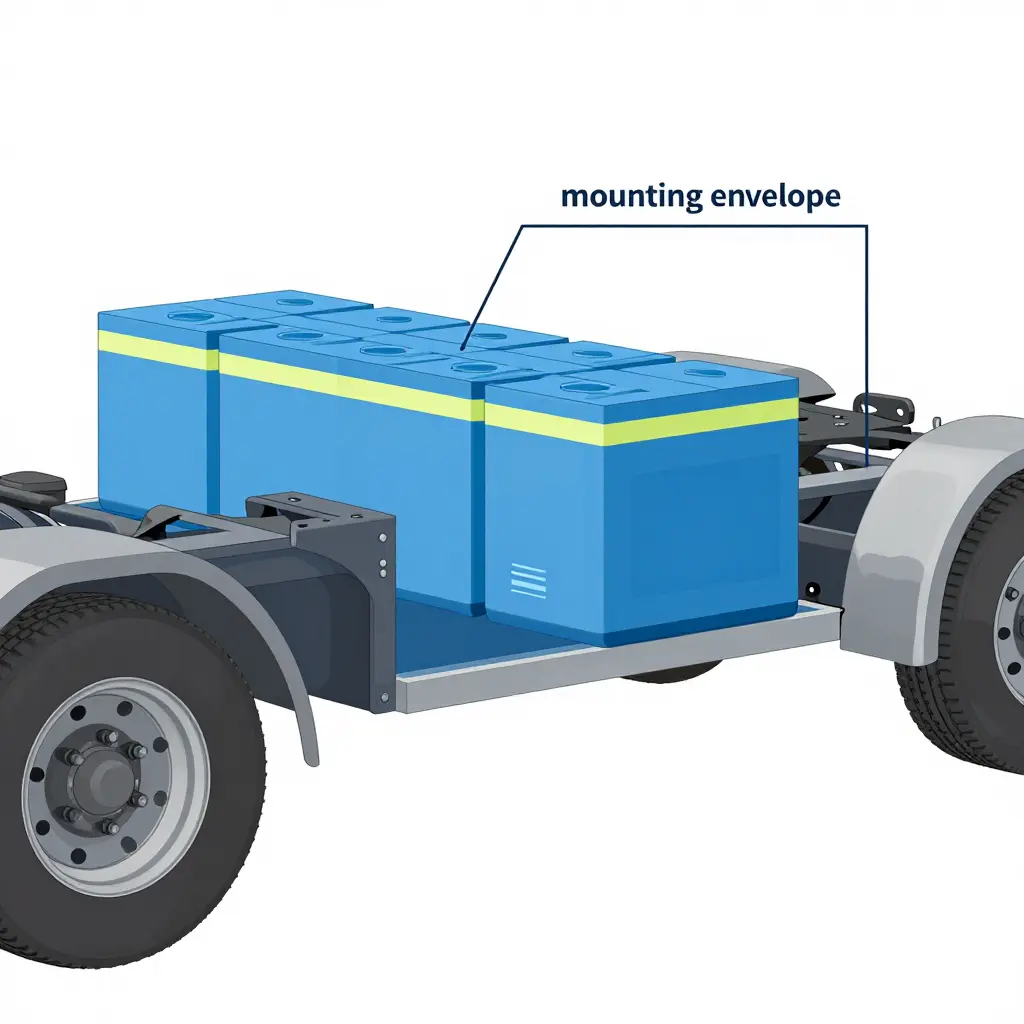
- Mounting envelope: the defined three-dimensional zone where aftermarket hardware may attach without intruding on the pack or its clearance limits.
These terms are the vocabulary of fitment that respects the platform’s geometry. They also explain why electric truck running board mounting points look so little like legacy designs — a problem that resurfaces when sourcing running boards from Chinese manufacturers.
Clearance Conflict Factors Between Battery Packs and Running Boards
Fitting running boards to an electric truck is rarely a simple bolt-on job. The pack rewrites the lower-body geometry, and the conflicts show up in the same few places every time.
-
Side sill intrusion by the pack. On most electric trucks, the high-voltage battery fills space that a combustion drivetrain would leave empty along the rocker panel. The pack envelope pushes outward toward the sill and consumes the gap that running board brackets have traditionally occupied.
-
Limited bracket standoff distance. Standoff arms have to be long enough to clear the body and carry a step load. When the pack claims that inward space, usable standoff shrinks, and standard mounting arms can end up touching, or nearly touching, the battery enclosure.
-
Jacking point interference. OEMs frequently relocate jacking points to sit within pack protection structures. A bracket bolted near one of those reinforced spots can block the jack, complicating both dealership service and roadside tire changes.
-
Wiring and cooling line routing along the sill. High-voltage cables and coolant lines commonly run through the rocker area. Drilling or clamping near them risks nicking a line, so installers must map the routing carefully before cutting any metal.
-
Ground clearance reduction. Every bit of added bracket depth lowers effective ground clearance, raising the risk of scraping on ramps, curbs, or speed bumps. That risk matters most on trucks whose pack underside already sits low to the ground.
-
Required preservation of crash structure. Battery enclosures are engineered as part of the crash load path and the side-impact deformation zone. A bracket that transfers impact force into the pack, or alters that zone, can compromise safety compliance and void powertrain warranties. That is why specialized running board manufacturers building for China’s EV truck market now design around pack geometry from the first CAD iteration.
These factors rarely appear one at a time. A single mount point can fight pack intrusion, standoff limits, and crash-structure preservation at once, which is why EV-specific running board designs diverge so far from their legacy-truck counterparts.
The table compares common pack configurations against the side-sill geometry and mounting clearances that decide which running boards can be installed.
| Pack Position | Side Sill Style | Available Mounting Standoff | Typical Running Board Type Compatibility | China Aftermarket Fitment Notes |
|---|---|---|---|---|
| Underfloor skateboard (flat, between axles) | Smooth, low-profile flush rocker | 20-40 mm | Low-profile bolt-on boards; limited power steps | Most universal kits need bracket redesign; clearance-tuned brackets dominate the aftermarket |
| Structural side-sill pack (pack forms the rocker) | Reinforced integrated pack wall | 0-15 mm | Clamp-on or adhesive trim only; no standard bolt-on | OEM-specific brackets required; drilling discouraged due to warranty and safety risk |
| Split under-seat and under-bed pack | Conventional body-on-frame rocker | 60-90 mm | Full range of tubular boards, running boards, and power steps | Legacy bracket patterns often fit; highest compatibility for aftermarket suppliers |
| Frame-mounted box pack (along ladder rails) | Exposed ladder-frame rocker | 80-120 mm | Heavy-duty boards and commercial step bars | Generous clearance; easy fitment; preferred by upfitters and import traders |
| Rocker-embedded pouch cell (low-slung bulge) | Convex, irregular bulge panel | 10-25 mm (variable) | Contour-matched boards only; mostly custom | Irregular surface defeats universal bracketry; custom jigs raise tooling cost |
Read across the standoff column and the pattern holds: as available standoff shrinks, compatible running boards drop from full power-step systems to contour-matched custom units. Every configuration where the pack intrudes into or replaces the side sill gives up standoff, and that lost clearance is what pushes China aftermarket running board suppliers toward bespoke brackets and vehicle-specific tooling instead of off-the-shelf fitment.
China-Specific Platform Architecture
How Skateboard and Battery-to-Body Designs Reshape Running Board Fitment
Electric truck design in China has moved away from the ladder-frame logic that governed internal combustion trucks for decades. Many domestic OEMs build on skateboard platforms, where a flat structural pack forms the vehicle floor and doubles as a load-bearing element. Others use battery-to-body designs — often called cell-to-chassis — that bond the pack directly into the body-in-white and do away with discrete frame rails. Either way, running board fitment starts from a different set of surfaces.
A legacy diesel or gas truck gave suppliers two stamped steel frame rails running the length of the cab, predictable rocker geometry, and ample vertical clearance — reference drawings that stayed valid for decades. A skateboard or battery-to-body platform has no exposed frame rails to clamp onto. Mounting surfaces are tied to the body instead: reinforced sills, dedicated boss points, or integrated brackets that also serve the battery enclosure.
OEM Styling and Cladding Shrink the Available Real Estate
Aerodynamic styling makes it tighter still. To reduce drag and extend range, Chinese OEMs wrap their trucks in side skirt cladding: flush rocker panels, wheel-arch flares, and underbody fairings that conceal the battery tray. The cladding is cosmetic and protective, but it also uses up surface area that running board brackets need. Pack placement eats into the rest — packs pushed low and wide leave only a narrow lip along the sill for hardware.
Because OEM clearances are seldom published, aftermarket suppliers reverse-engineer mounting geometry from physical vehicles. That makes electric truck running board manufacturing in China a job of field measurement, tolerance stacking, and prototyping rather than drawing-based engineering. It also explains why a bracket engineered for one platform rarely transfers cleanly to another: fitment in China rewards suppliers who invest in adaptive, vehicle-specific tooling.
The Physical Conflict: Where a Running Board Would Go
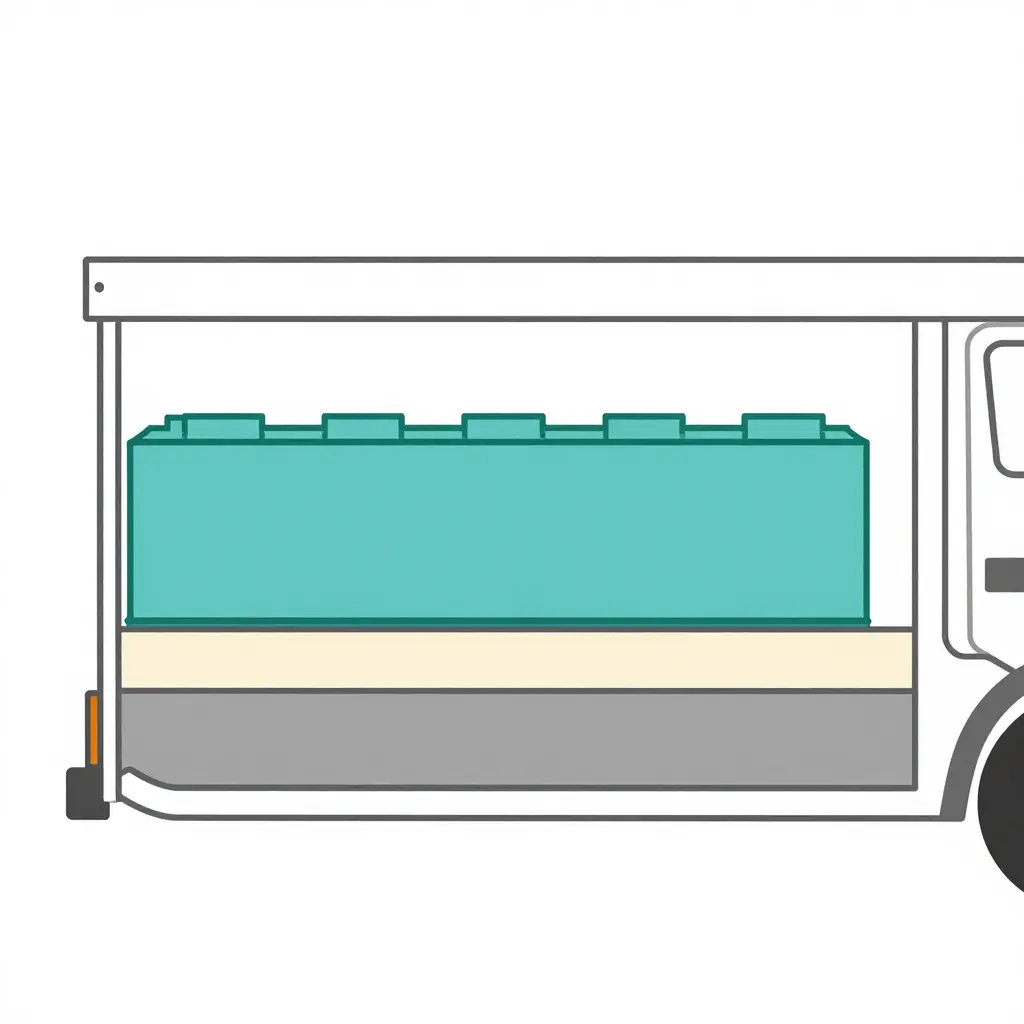
The geometry itself explains most of the problem. This diagram is a simplified 2D cross-section of an electric truck’s side sill — the structural rocker region running along the lower flank of the vehicle.
Reading the Diagram
On an internal-combustion truck, the outer lower sill and rocker panel give you a simple, structurally dense surface for bolting on side steps and running board brackets. On a battery-electric platform, that same space is heavily contested. Three zones dominate the cross-section:
- The battery pack — a large, load-bearing module nested within or directly beneath the sill envelope, often protected by an integrated skid plate and cooling structure.
- The clearance zone — a thin but non-negotiable air gap separating the pack from surrounding bodywork, required for impact crush space, thermal expansion, and service access.
- The mounting region — the outer lower surface where running board hardware would classically attach, now sitting directly above or adjacent to that protected clearance volume.
The point is simple: the battery pack clearance occupies the very space that running board mounting hardware needs. A bracket that intrudes into that gap risks contacting the pack enclosure, voiding warranties, or compromising crash safety margins. For electric truck running board suppliers selling into the China aftermarket, that is the root of the fitment uncertainty.
Engineering and Fitment Impact of Battery Pack Clearance
A Smaller Envelope Changes Everything Downstream
A diesel truck’s rocker panel and frame rail offer generous flat real estate. On an EV, the battery pack consumes that zone, so electric truck running boards have to be engineered around a much tighter envelope, and every downstream decision inherits the cost.
The first consequence is fewer viable bracket options. A combustion truck might accept three or four bracket geometries; here, maybe one. Designers lose the freedom to tune drop, offset, and reach per trim level, so a single compromise shape serves the whole range.
Longer standoffs become unavoidable. Reaching from a recessed attachment point out to the board adds leverage, which raises bending stress and demands thicker gauges or added gussets. The added mass then works against the load path: instead of routing forces straight into the frame, loads travel through long, offset cantilevers that are inherently less stiff.
Corrosion and vibration add to the problem. Standoffs and hardware sit close to the pack’s thermal envelope and to road spray, which speeds galvanic and crevice corrosion. Longer brackets also store more vibration energy, so fasteners loosen and joints fatigue sooner.
The board itself can also lose ground clearance. To clear a lower, wider pack, a functional step may end up almost flush with the underbody, raising scrape risk on ramps and speed bumps.
Together, these factors add up to more prototyping, stricter validation, and a slower path to market for every new EV platform. A sourcing partner that already knows the trade-off, such as an established electric truck running boards manufacturer in China, can shorten that cycle.
The Clearance-Compatibility Curve
The chart plots two variables for five battery-pack architectures typical of the China EV aftermarket: available mounting standoff (the vertical gap between the pack’s outer shell and the chassis rail, measured in millimetres) and running board fitment compatibility (the estimated share of aftermarket side-step kits that mount without interference, expressed as a percentage). The figures are illustrative estimates for comparison, not measured field data.
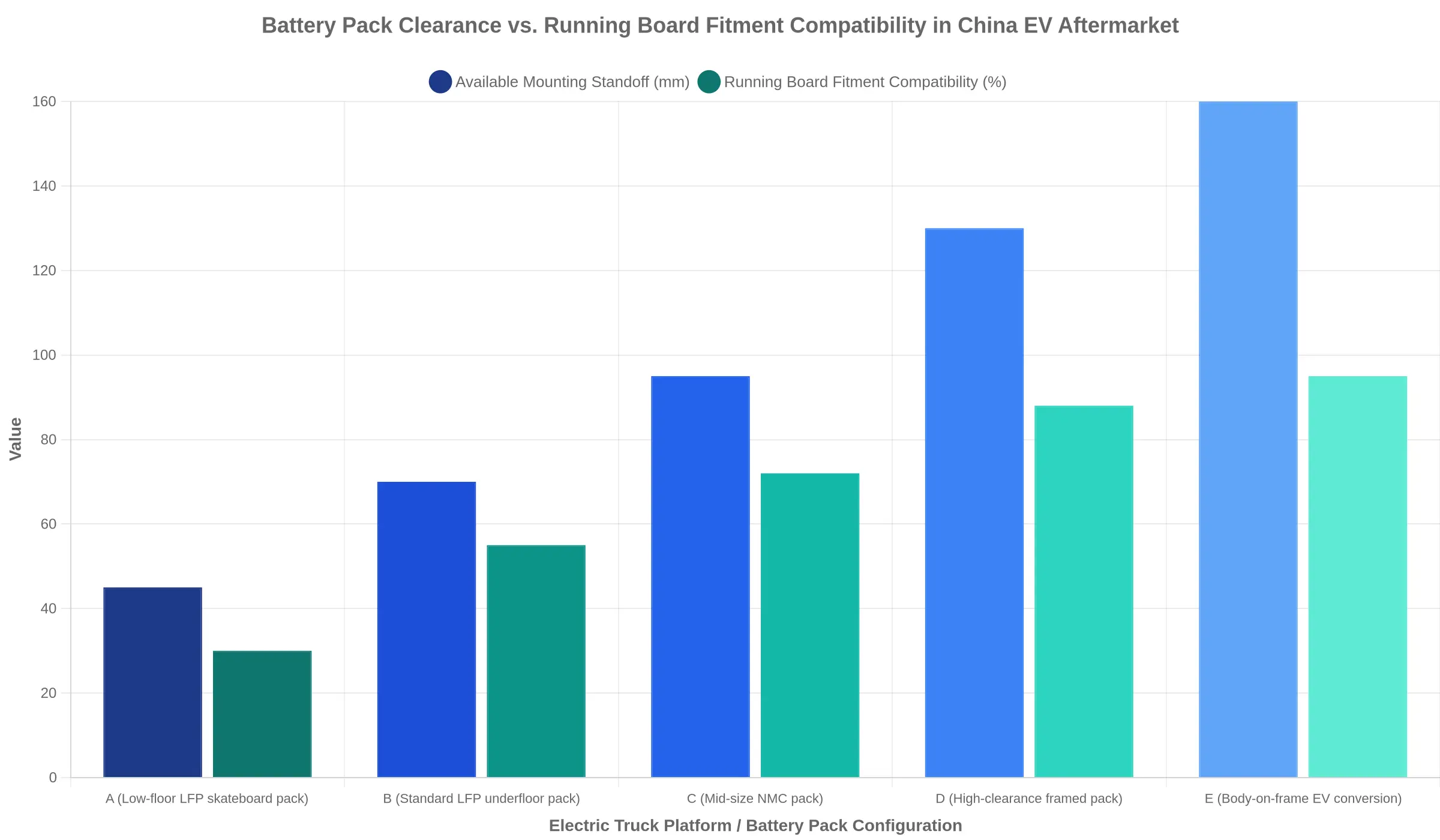
Figure 1. Available mounting standoff (blue series) versus running board fitment compatibility (teal series) across five electric truck platform and battery pack configurations. Both series move together: as standoff tightens from 160 mm down to 45 mm, fitment compatibility falls from a near-universal 95% to just 30%.
The five points fall on a near-straight line, which makes the trend easy to read but is a simplification — treat it as a comparison model rather than a fitted result. Platforms built on low-floor LFP skateboard packs leave roughly 45 mm of usable standoff, and that constraint drags fitment compatibility down to about 30%, because mounting brackets, reinforcements, and wiring looms have nowhere to sit. A standard LFP underfloor pack at 70 mm reaches 55%; a mid-size NMC pack at 95 mm, 72%; a high-clearance framed pack at 130 mm, 88%; and a body-on-frame EV conversion with 160 mm of standoff supports a 95% fit rate.
For the aftermarket, the useful reframe is that this is a packaging problem, not a bracket problem. A supplier such as a China-based electric truck running board manufacturer that engineers a single universal kit is effectively designing for the median standoff, and that leaves the tightest, fastest-growing low-floor platforms chronically underserved. The tighter the pack, the more a running board has to be a platform-specific, low-profile solution rather than a one-size-fits-all retrofit.
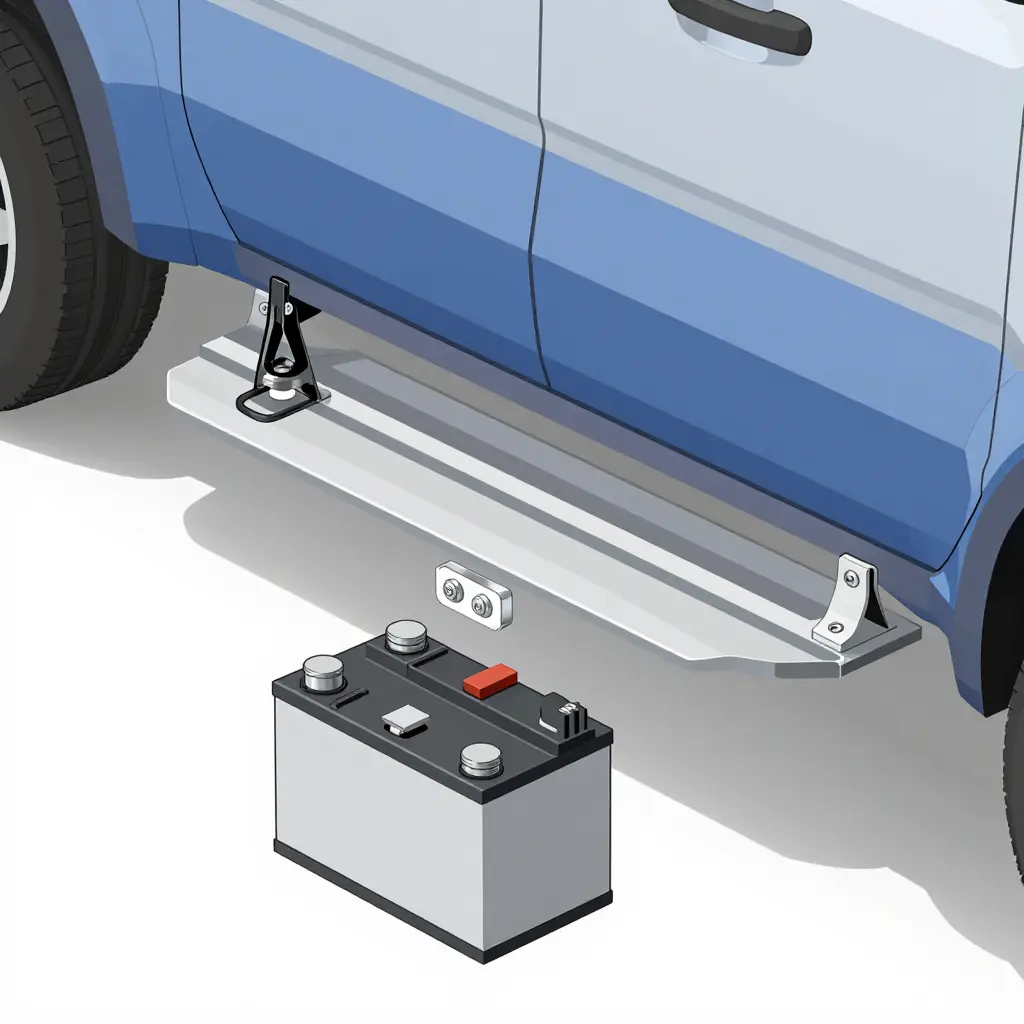
When OEM mounting points sit directly over a high-voltage pack, generic drilling templates are no longer safe or legal. The answer is a modular mounting architecture that transfers load laterally into the frame rather than vertically through the battery enclosure. Reputable running board manufacturers in China now ship these EV-specific kits as standard.
Bracket Design, Clamping Mounts, and Load Paths
Custom bracket design is the first line of defense. Upfitters model the frame rail and pack perimeter in CAD, then fabricate brackets that pick up existing factory fastener locations instead of drilling new holes. Non-intrusive clamping mounts wrap around the frame section, eliminating any penetration of the battery enclosure and preserving the OEM corrosion warranty.
Adjustable standoff systems give installers a tuning range, letting the step move outboard for cabin access or inboard to recover clearance. Load-spreading plates under each fastener distribute point loads across a wider surface, reducing stress concentration on thin-walled frames and composite rockers.
Material choice then shapes the trade-off between weight and stiffness.
| Material | Weight | Stiffness / Load Capacity | Corrosion Resistance | Relative Cost |
|---|---|---|---|---|
| 6061-T6 Aluminum | Low | Moderate | High (with coating) | Moderate |
| HSLA / Hot-Rolled Steel | High | Very High | Moderate (needs e-coat) | Low |
| Reinforced Composite | Very Low | Moderate | Excellent | High |
Aluminum saves mass and preserves payload but demands thicker sections to match steel stiffness. Reinforced composite resists corrosion and isolates vibration yet complicates repair. Steel remains the cheapest and strongest option, but it adds weight and demands rigorous coating.
Every adaptation trades structural safety, ground clearance, and cost against the others. Aggressive outboard offsets improve ergonomics but reduce clearance and increase bending moment. Overbuilt brackets maximize safety but raise weight and price. The design should be verified with finite element analysis and physical load testing before it reaches a customer’s truck.
Fitment Evaluation Steps for Electric Truck Running Boards
Before drilling a single hole, treat battery pack clearance as the governing constraint. The sequence below protects both the high-voltage pack and the structural integrity of the truck.
-
Confirm battery pack geometry and jacking points. Pull the OEM body builder’s guide to map the high-voltage pack envelope, the service-disconnect location, and the approved jacking zones. Mounting hardware must never intrude on any of them.
-
Verify standoff limits. Measure the vertical and lateral gap between the pack casing and the intended running board bracket, and confirm the standoff leaves room for thermal expansion, road debris, and cooling-air movement.
-
Check crash structure. Identify the rocker-panel reinforcements and side-impact beams, and anchor every bracket to load-rated structural points rather than thin cosmetic panels.
-
Confirm ground clearance. Calculate the lowest bracket position against the truck’s laden ride height and approach/departure angles. Added battery weight lowers the chassis far more than an equivalent diesel truck.
-
Perform final validation. Road-test over speed bumps and uneven terrain, re-torque every fastener to spec, and scan for warning codes tied to pack pressure or temperature sensors after the install.
For suppliers building compatible hardware, understanding electric truck running boards manufacturing requirements early shortens this entire workflow and reduces costly warranty returns.
FAQ: Electric Truck Running Board Fitment and Battery Pack Clearance
Do aftermarket running boards void my electric truck’s warranty?
Not automatically. Under the U.S. Magnuson-Moss Warranty Act, a manufacturer can deny warranty coverage for a specific failure only if the aftermarket part actually caused it; several other markets have comparable rules. But if a poorly mounted bracket contacts or damages the high-voltage battery enclosure, that related repair claim can legitimately be rejected. Document your installation and keep torque specifications on file.
Why do universal running board kits so often fail to fit electric trucks?
Universal kits are engineered around the flat, accessible frame rails of combustion trucks, where mounting points are predictable and the underbody is largely open. Electric trucks replace that empty space with a large, sealed battery pack that frequently protrudes below the rocker panel, so the same bracket that clears a diesel frame can collide with the pack housing. The result is interference, uneven standoff, or mounting holes that simply do not line up.
Is drilling ever acceptable when installing running boards on an EV?
Rarely, and never into the battery enclosure. Drilling into a structural frame rail can introduce corrosion and stress risers, while piercing the pack housing risks coolant leaks, loss of ingress protection, and a serious safety hazard. If a kit demands new holes, the bracket design is likely wrong for that vehicle. Reputable manufacturers build direct-fit hardware that reuses factory-threaded locations.
How do running boards affect ground clearance and battery pack protection?
A properly designed running board tucks close to the rocker and preserves most of the vehicle’s clearance, while an oversized or poorly positioned step can reduce breakover angle and snag obstacles. Because the battery pack is the lowest and most vulnerable component, sagging boards or exposed brackets that hang below the pack offer false protection rather than real shielding. Prioritize step designs that match the pack’s ground-clearance envelope.
Are OEM running board options more reliable than aftermarket ones?
OEM boards are validated against the exact battery enclosure geometry, so fit and clearance are guaranteed — but they are expensive and limited in style. A well-engineered aftermarket board can match OEM fitment at a lower cost, provided it is truly vehicle-specific rather than universal. For buyers sourcing in volume, working with a dedicated electric truck running board manufacturer ensures the brackets and pack clearances are validated against real production vehicles before shipment.
Market and Sourcing Perspective: Running Board Fitment in China’s EV Aftermarket
The commercial outlook for electric truck running board fitment in China is shifting fast. Battery-electric truck production keeps climbing, and aftermarket suppliers are reworking product lines that were originally built around diesel-era chassis.
Suppliers are moving away from generic, one-size-fits-all bars. Because battery pack placement dictates mounting geometry, vendors increasingly build platform-specific kits engineered around a given chassis, wheelbase, and voltage architecture. This modular approach lets a single supplier cover several OEM platforms without drowning in slow-moving stock.
Demand for platform-specific kits is strongest among distributors and upfitters, where a fitment error is costly. A bracket that clashes with a battery enclosure is not a minor flaw — it can void a warranty or create a safety risk. Buyers therefore reward suppliers who publish clear fitment data, torque specs, and installation guides, like those outlined in our guide on how to evaluate an electric truck running boards manufacturer in China.
Import and export demand shapes product development in a second direction. Overseas dealers want drop-shipped, complete kits with hardware, instructions, and compliance paperwork, while fleet partners want consistency across repeat orders. That pull is steering Chinese manufacturers toward standardized packaging and platform-locked SKUs — a trend reflected in the wider 2026 electric truck market share and delivery data reshaping global demand.
We expect platform-specific kits to overtake universal-fit products in the China aftermarket through 2028.
EV Special Trucks works in exactly this space. We are a B2B supplier exporting electric special trucks worldwide, supporting custom configurations and full-set export programs for international dealers and fleet partners. The range runs from fitment-ready running boards to complete vehicle programs.