
Why Cold Start Range and Compactor Duty Cycle Govern Electric Garbage Truck Feasibility
Put an electric garbage truck on a sub-zero collection route and two numbers decide whether it finishes the shift: the range available from a cold pack, and what the compactor costs per cycle. Battery capacity, motor rating and peak payload matter less once the temperature drops below freezing. A truck can carry a large pack and still strand a crew if too little of that energy is usable at -20 °C, or if every compaction stroke quietly drains the reserve.
Cold Start Range on Estonian Winter Routes
Cold does two things at once. It shrinks what a lithium-ion pack can deliver, and it raises what the truck asks of that pack: cabin heating, hydraulic warming, denser frozen refuse. On Estonian winter routes, short daylight, salted roads and continuous stop-start duty push consumption past summer baselines.
Field data for electric refuse platforms show only a fraction of rated range surviving at -10°C to -20°C, and duty-cycle traces show the compactor taking a disproportionate share of the remaining battery capacity during peak-load windows. Fleet managers reviewing an electric garbage truck for sale in Estonia should compare those two figures side by side, not one at a time.
That is why winter specifications have to be judged together. A truck that meets its range target but underperforms on compaction, or compacts well but cannot finish the route, is unsuitable either way. Cold start range and compactor duty cycle act as one coupled constraint, and that pair, not the nameplate range, sets the real procurement benchmark.
Cold Start Range Mechanics: How Ambient Temperature Cuts Usable Range
On a cold-climate electric refuse truck, the nameplate range figure is a fair-weather number. What an Estonian or Scandinavian winter actually delivers depends on four mechanisms, and all four pull the same way: they cut the energy the pack can give while raising the energy the truck needs.
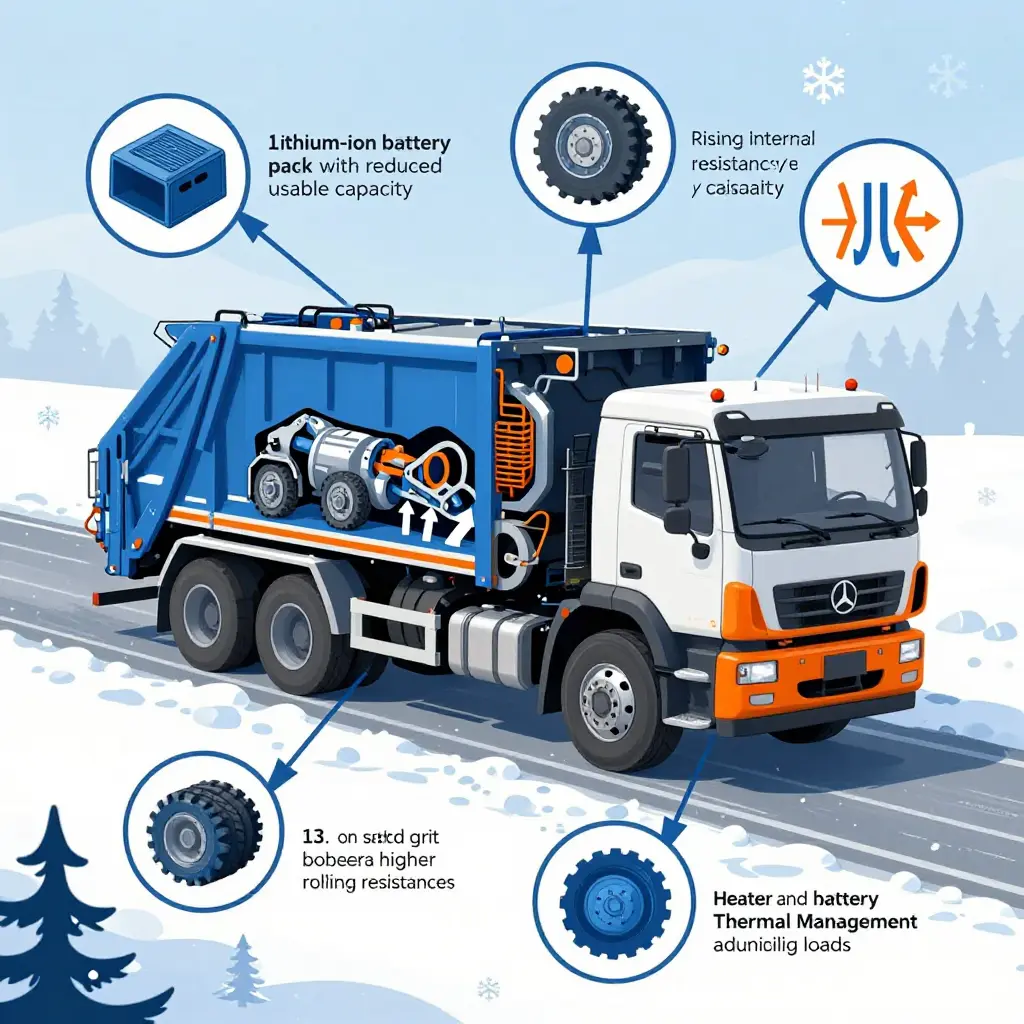
Reduced lithium-ion available capacity. Cold cells slow electrolyte conductivity and electrochemical reaction kinetics, so the pack releases only a fraction of its nominal amp-hours. For planning, assume near-full retention near +20 °C, roughly 90% at 0 °C, and only 55-65% at extreme cold around -30 °C.
Increased internal resistance. Resistance climbs as cells cool, so terminal voltage sags harder under load. A collection route with frequent compactor and bin-lift demands hits the power limit sooner, which trims the usable capacity window again.
Higher rolling resistance on treated winter roads. Studded and winter tires, loose grit, slush and compacted snow all raise rolling resistance and driveline drag. Depending on the surface, that adds roughly 10-30% to the energy consumed per kilometre: the same distance for more kilowatt-hours.
Auxiliary loads from heating and battery warming. Cabin heating and active battery thermal management draw power continuously. In deep cold, and especially while the pack is being brought up to a safe operating window, those auxiliaries can match traction consumption on stop-and-go duty.
The retention curve below shows the net effect.
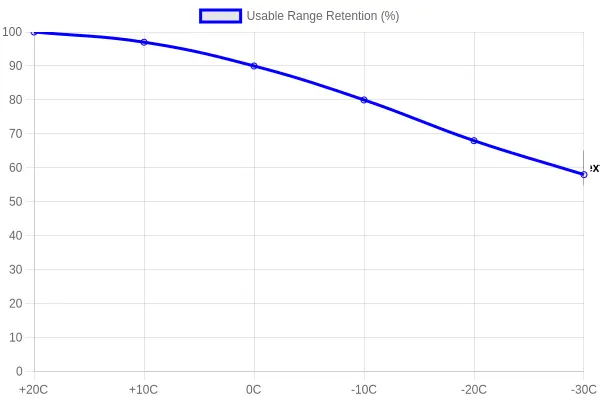
| Ambient temperature | Usable range retention | Primary driver |
|---|---|---|
| +20 °C | ~100% | Baseline |
| 0 °C | ~90% | Mild kinetics loss |
| -10 °C | ~80% | Rising internal resistance |
| -20 °C | ~68% | Capacity loss plus auxiliary load |
| -30 °C | ~58% | Full cold penalty |
Cold start range versus steady-state range
Cold start range is what a cold-soaked pack delivers after a night at ambient temperature. That is the first-route figure a fleet has to plan around. Steady-state range is reached only after the pack warms up, resistance falls and capacity partly returns. The gap between the two is the planning margin that decides whether a winter route finishes on a single charge. A truck bought for these conditions should be specified as a cold-climate electric refuse truck from the start, not as a warm-market platform retrofitted for winter. For a practical reference point, see how an electric garbage truck is configured for Estonian winter routes.
Cold-Start Range vs. Ambient Temperature
The table below runs a representative heavy-duty electric refuse truck, with a roughly 283 kWh usable pack and a fully electric compactor, through five ambient temperature bands drawn from real Estonian winter routes. Use it to plan routes and charging infrastructure before committing capital, because cold-start usable range and compactor duty capacity do not fall at the same rate. A shortlisted platform can be checked against the same assumptions via electric garbage truck specifications for Estonian winter routes.
Table 1. Electric Garbage Truck Cold Start Range by Ambient Temperature Band – presented as procurement-planning evidence so buyers can quantify worst-case winter duty before ordering.
| Ambient Temperature | Nominal Rated Range | Cold Start (Usable) Range | Range Retention | Estimated Winter Energy Consumption (kWh/km) | Compactor Cycles Achievable per Charge |
|---|---|---|---|---|---|
| +20 C | 210 km | 210 km | 100% | 1.35 | 1,280 |
| +5 C | 210 km | 184 km | 88% | 1.55 | 1,050 |
| -5 C | 210 km | 149 km | 71% | 1.90 | 860 |
| -15 C | 210 km | 115 km | 55% | 2.45 | 670 |
| -25 C | 210 km | 85 km | 40% | 3.35 | 510 |
Note: All figures assume a ~283 kWh usable battery envelope. Driving range and compactor cycles draw on the same energy reserve, so mixed collection routes will not simultaneously achieve the maximum of both columns; the cycle counts shown represent a compacting-dominant duty cycle at each temperature band. Nominal rated range is the manufacturer figure at +20 C under mixed duty.
Compactor Duty Cycle Analysis
A refuse collection route is not a steady load. It is a run of short, high-draw hydraulic events layered over intermittent traction demand, and on an electric garbage truck that sequence, not the steady-state highway figure on the datasheet, defines real-world range. Teams sizing battery capacity for Estonian winter routes have to treat the compactor duty cycle as a major energy consumer in its own right.
Phase-by-phase route sequence
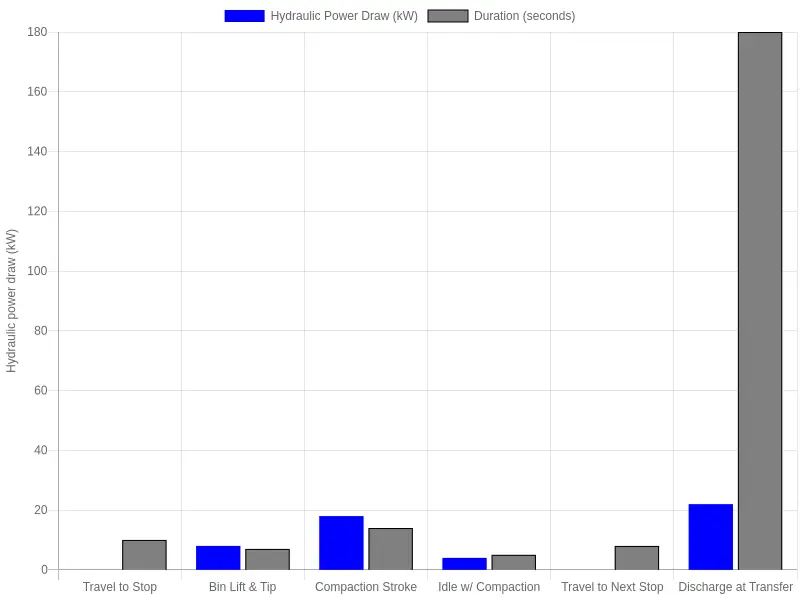
Every bin stop follows the same loop: travel to the stop, bin lift and tip, compaction stroke, idle with the packer holding, travel to the next stop, and periodic discharge at the transfer point. Hydraulic draw and duration differ sharply from one phase to the next.
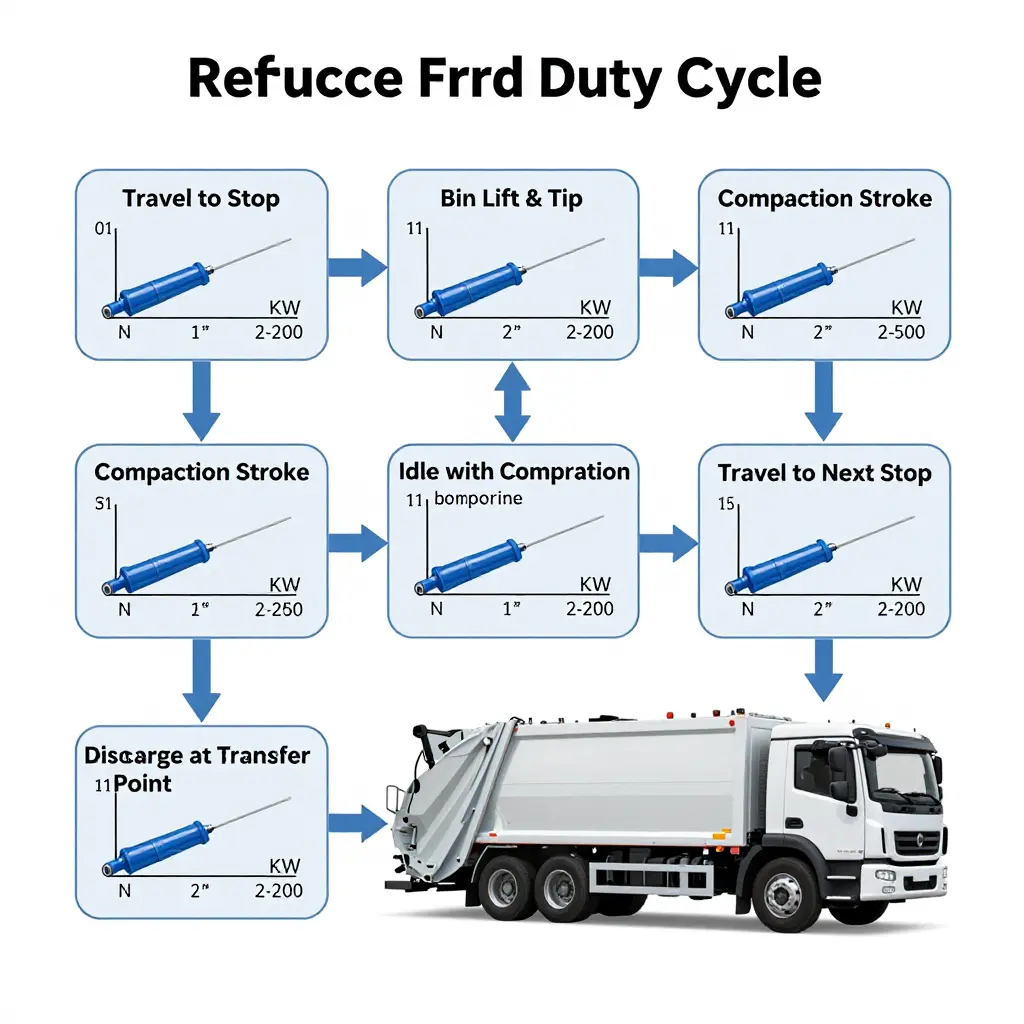
| Phase | Duration (s) | Hydraulic power draw (kW) |
|---|---|---|
| Travel to stop | 8-12 | 0 (traction only) |
| Bin lift and tip | 6-8 | 7-9 |
| Compaction stroke | 12-16 | 16-20 (peak) |
| Idle with compaction | 4-6 | 3-5 (holding pressure) |
| Travel to next stop | 8-10 | 0 (traction only) |
| Discharge at transfer point | 150-200 | 20-25 continuous |
ePTO load versus traction energy
An electric PTO (ePTO) drives the compactor from the same DC bus as the traction inverter. When the packer strokes while the truck creeps forward, both loads pull at once, so the pack’s instantaneous C-rate climbs even though average speed is low. Cold makes this worse. At 0 C or below a lithium pack carries higher internal resistance, and a 20 kW hydraulic transient on top of traction demand deepens the voltage sag, which forces the controller to cut back output.
How repeated cycles shrink route range
Energy is dominated by the repeated compaction stroke:
- Compaction stroke: 18 kW x 14 s = 252 kJ = 0.070 kWh per stop
- Bin lift and tip: 8 kW x 7 s = 56 kJ = 0.016 kWh per stop
- Per-stop body total = 0.086 kWh
- 800 stops per route = 69 kWh of body energy
Traction is the other side of the ledger. A 120 km route at 1.2 kWh/km draws 144 kWh; add 69 kWh of compactor duty and the route needs 213 kWh. On a 250 kWh pack with 225 kWh usable, the body accounts for roughly 32% of route energy, and effective range falls from about 188 km to 127 km.
The point for procurement is that every compaction cycle compounds, so range tracks stop count rather than distance. Fleets evaluating an electric garbage truck for Estonian winter routes should size packs against stops and cold-start heating, not highway range alone.
Cold Start Range Degradation vs Ambient Temperature
For municipal fleets in Estonia and the wider Baltic region, the most consequential specification question is not nominal range on a laboratory cycle. It is how much usable range remains when a truck leaves an unheated depot at -20 C. Battery chemistry, cabin heating demand and cold-thickened lubricants all compound, and the effect is non-linear: each degree below freezing costs proportionally more range than the one before it.
The chart below plots that relationship for a representative 180 km nominal-range electric refuse chassis, from a mild +20 C baseline down to the -25 C that is typical of an Estonian January morning.
What the curve shows
The descending line is not a worst-case marketing figure. It tracks the compounding losses real fleets observe in the field:
- +20 C to 0 C: A moderate, gradual decline of roughly 12% as cabin preconditioning and battery thermal management begin drawing load.
- 0 C to -10 C: The slope steepens; resistance heating and reduced electrolyte conductivity push losses past 20%.
- -10 C to -25 C: The most aggressive losses occur, with usable range falling to approximately 100 km at -25 C – a total shortfall near 45% against the warm-weather baseline.
For a route planner, the practical rule is to size winter assignments against the cold column, not the nominal one. A compactor duty cycle that fits comfortably within 180 km in summer may need a mid-route top-up or a depot return to stay viable at -25 C. That is why cold-climate specifications should require a certified low-temperature range figure alongside the standard cycle rating.
Fleets specifying equipment for these conditions can review proven winterised configurations in the electric garbage truck range built for Estonian routes, where battery thermal management and heater strategy are engineered around sub-zero duty rather than added afterwards.
Specification implications
The gap between warm and cold performance drives three procurement decisions: a larger usable battery buffer than a temperate-climate fleet would select, a diesel or electric auxiliary heater that avoids draining traction energy, and a route allocation model that treats winter range as the design constraint. Read the curve correctly and the fleet holds its schedule all year; read it as a summer number and it quietly underperforms every February.
Compactor Duty Cycle Phases
On a rear- or side-loader electric garbage truck, the compactor duty cycle is a fixed, repeating sequence, and on Estonian winter routes every phase draws power from the traction battery under cold-load conditions. Knowing how these five phases interact is the first step toward specifying a truck that holds its State of Charge (SoC) across a full 8-10 hour shift.
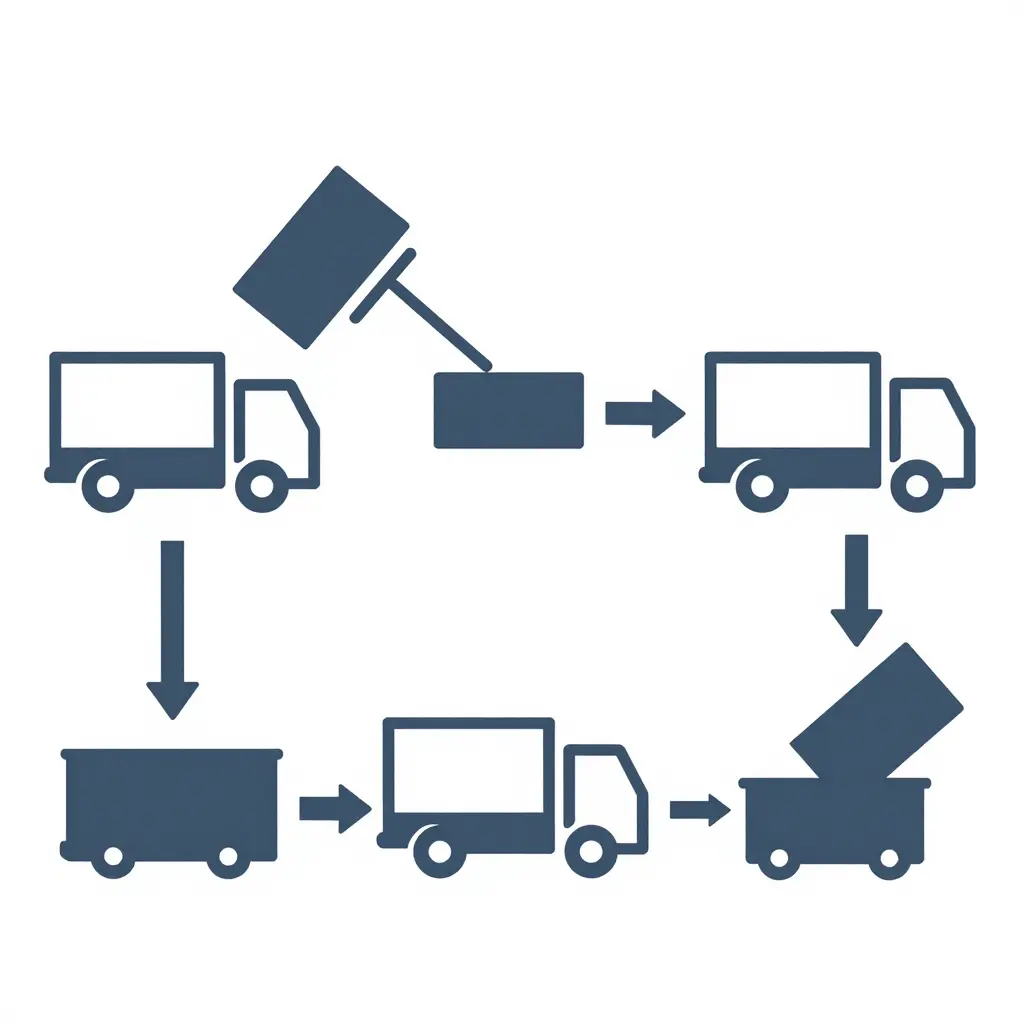
The Five Phases at a Glance
- Travel to stop: the truck moves incrementally between collection points at low speed, drawing tractive energy from the battery.
- Bin lift and tip: the hydraulic lift raises and inverts the bin; an electric-motor-driven pump converts and discharges energy.
- Compaction stroke: the packing ram cycles to reduce waste volume, typically the highest instantaneous hydraulic load in the sequence.
- Travel to next stop: the truck repositions, often with only a few metres between adjacent bins.
- Discharge at transfer point: the body ejects the compacted load, a single high-torque, energy-intensive event per route.
Why the Sequence Matters in a Cold Climate
High stop density makes the travel phases short but frequent, while the lift, stroke and discharge phases create recurrent hydraulic peaks. On a winter route, low ambient temperatures raise electrolyte resistance and cabin and body heating demand, so those hydraulic peaks compete with traction and thermal loads for the same stored energy. Fleets that map this duty cycle against real kerbside distances tend to over-specify usable battery capacity rather than rely on nameplate range figures alone.
For a fully configured Estonian winter footprint, see this guide to an electric garbage truck for Estonian winter routes, which pairs the duty cycle above with cold-start range and SoC targets.
Battery Thermal Management and Cold-Start Preconditioning for Estonian Winter Routes
An electric refuse truck parked overnight at -20°C is not ready to work at peak efficiency. Lithium-ion cells lose both power and usable capacity when cold, and a compactor duty cycle stacks heavy cyclic loads on top of traction demand. Sound battery thermal management is therefore a procurement requirement, not a comfort option.
Active Liquid Heating
Current 350-400 kWh refuse packs use liquid-cooled modules with a glycol-water coolant loop. An onboard 5-8 kW heater (PTC or heat-pump assisted) brings the pack into a 15-30°C operating window. Below -10°C, DC charging is throttled and internal resistance climbs sharply, so heating has to precede energy draw. Holding pack temperature at -20°C ambient typically costs 4-6 kW continuous.
Pack Insulation
Insulation reduces heat loss and cuts heater duty. Specify a sealed enclosure with a minimum ~25 mm thermal layer plus a low-power 200-500 W heater for soak periods. That keeps cells above the -10°C charging threshold across short depot breaks and limits overnight heat loss to just a few degrees.
Depot Preconditioning While Grid-Connected
Preconditioning runs while the truck is plugged into shore power. A 22-43 kW AC charger drives the thermal system and warms the cabin and hydraulics before the shift. Because that energy comes from the grid, the pack leaves the depot already at temperature and avoids paying a cold-start penalty at the first collection point.
Shifting Cold-Start Demand Off the Battery
Left unheated, a truck can burn 8-12 kWh merely reaching operating temperature on the first route. Preconditioning pushes that load upstream to the depot and saves the traction battery for propulsion and compaction. The measurable payoff is cold start range: preconditioning can recover 20-40 km of usable range versus a cold-soaked departure.
The Cost-Range Trade-Off
Preconditioning is not free. Grid energy spent warming the pack returns range on a diminishing curve, and warming past roughly 15°C buys little extra range for the additional kWh. Size preconditioning against route length and forecast ambient, not maximum heat input.
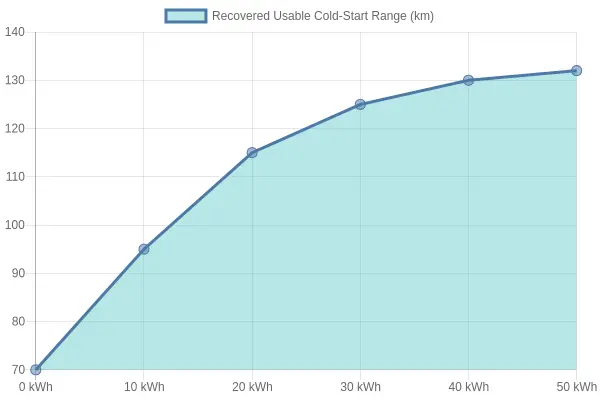
Auxiliary loads come out of the same energy budget: 12V systems, cab heaters and work lights draw energy that would otherwise warm the pack. Managing them is part of the same efficiency equation; see this guide on managing 12V and auxiliary loads.
Depot Charging and Winter Energy Planning
Charging an electric garbage truck fleet at the depot is a power-planning problem, not a plug choice. Teams should size chargers around the usable kWh that must be delivered inside the dwell window, then discount for cold-weather charging losses, which can add 10-15% to the energy actually drawn from the grid.

Charger Sizing and the Overnight Window
A truck back at 17:00 and out again at 05:00 gives a 12-hour window. With a compactor duty cycle consuming roughly 1.4-2.0 kWh/km, a 120 km Estonian winter route shift draws about 190-280 kWh. The onboard or depot charger has to refill that without stressing the site supply.
| Charger type | Output | Overnight energy (12 h) | Best fit |
|---|---|---|---|
| AC depot post | 22 kW | ~260 kWh | Single-shift, 250 kWh battery |
| AC dual split | 2 x 22 kW | ~260 kWh shared | Two trucks per post |
| DC depot fast | 60-120 kW | 400+ kWh | Back-to-back shifts, top-up |
Preconditioning and Depot Power Demand
Cabin and battery preconditioning draws 5-15 kW per truck. If every vehicle preheats at 05:00, coincident demand can double the depot peak and trigger expensive transformer upgrades. Managed scheduling staggers charging and shifts preconditioning earlier to flatten the load curve.
Cold Start Range Shortfalls
At -20°C, an electric garbage truck on Estonian winter routes typically delivers only 65-75% of rated range. That shortfall forces schedule and route changes: add opportunistic top-ups, shorten dense collection loops, or reserve the longest routes for the newest battery packs.
Cost-per-Kilometre Implications
Cold-weather inefficiency pushes cost per kilometre upward. Applying a rigorous charging cost methodology lets fleet managers model the true winter figure rather than the mild-weather one. When specifying new assets, wholesale refuse truck sourcing context clarifies which battery, charger and route-allocation combinations suit Baltic duty cycles.
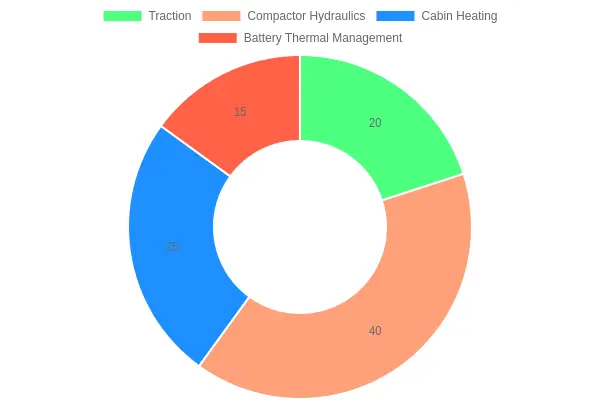
The doughnut chart above breaks total winter energy demand on an electric garbage truck into its four dominant subsystems. On Estonian winter routes, the traction motor is rarely the largest consumer: once ambient temperatures fall below freezing, the powertrain operates at reduced efficiency while two load categories, thermal management and work functions, expand sharply.
Where the winter energy goes
| Subsystem | Winter share | Why it grows in cold weather |
|---|---|---|
| Compactor Hydraulics | 40% | Packing cycles run at low hydraulic-fluid viscosity; pressure spikes and simultaneous lift/pack strokes draw peak current at every stop |
| Cabin Heating | 25% | Resistive or heat-pump cabin heating runs continuously across an 8-12 hour shift |
| Traction | 20% | Rolling and drivetrain losses rise on snow and ice, but regenerative braking partially offsets the penalty |
| Battery Thermal Management | 15% | Active heating brings the pack into its optimal temperature window for charging and discharge |
Together, compactor hydraulics, cabin heating and battery thermal management account for roughly 80% of winter energy use. That is the number procurement should plan around: the auxiliary and compactor duty cycle, not the driving range alone, dictates how often a truck must return to the depot to recharge. Fleets specifying units for Baltic conditions should size the pack around the compactor duty cycle and thermal loads first. Sample configurations are in this guide to in this guide to electric garbage trucks built for Estonian winter routes.
Route Planning and Payload Trade-Offs in Winter Conditions
In a Baltic winter, cold start range is the binding constraint on every collection cycle. Not axle load, not bin count, but the usable kilowatt-hours left after the pack is cold-soaked overnight at -20 C. A chassis that returns 230 kWh of traction energy in July may deliver only 165-180 kWh in January, once cabin heating, battery thermal management and denser air drag are accounted for. That is a 25-35% derating baked into the route before the first bin is lifted.
That single number cascades through the whole route sheet. Because energy per stop is roughly fixed (lift, tip, compact, reposition), a shorter cold start range forces at least one of three adjustments:
- Fewer stops per load – trim from ~900 lifts toward ~650.
- Shorter loop distance – cut a 95 km route down to ~70 km.
- Lower usable payload – leave 1-1.5 t of body capacity unused rather than overload soft winter ground.
Compactor Duty Cycle Compounds the Drain
The compactor duty cycle is the hidden variable in any cold-weather energy budget. Packing at a 60% duty cycle can pull 8-14 kW continuously, while a 35-40% duty cycle on lighter, pre-sorted waste draws only 5-8 kW. Across a 6-hour shift, that gap equals 18-36 kWh – enough to decide whether the truck finishes the route or calls for a mid-route swap.
Cold hydraulics make it worse: oil viscosity rises, pump efficiency falls, and each pack stroke consumes more energy for less compaction. Below -10 C, treat hydraulic pre-heating as mandatory, not optional.
Segmentation and Mid-Route Opportunity Charging
Split dense urban loops into 2-3 segments, with a depot or transfer-station stop between them. A 30-45 minute DC opportunity charge at 50-80 kW can return 25-50 kWh, restoring roughly 15-30 km of winter range and one full packing cycle. Plan the break where the body is already empty so charging and tipping overlap.
Matching Body Capacity to Achievable Range
Size the body to the energy, not the other way round.
| Ambient Temp | Usable Pack Energy | Practical Route | Recommended Body |
|---|---|---|---|
| +20 C | 230 kWh | 95-110 km | 18-20 m3 |
| 0 C | 200 kWh | 80-90 km | 16-18 m3 |
| -20 C | 165-180 kWh | 60-72 km | 14-16 m3 |
For Estonian municipal fleets finalizing a spec, review electric garbage truck configurations built for Estonian winter routes before locking axle ratings and body volume.
Frequently Asked Questions: Cold-Start Range and Compactor Duty Cycle
How much range does an electric garbage truck lose at -20 °C?
Expect a cold start range reduction of roughly 25-35% versus a 20 °C baseline. A refuse truck rated at 200 km nominal range typically drops to about 130-150 km at -20 °C once cabin heating, battery warming and higher rolling resistance are factored in. In Estonia, that translates to a realistic 120-140 km usable window before recharge, so most municipal routes run well within a 90-110 km working envelope.
How many compactor cycles can one charge support in winter?
A 350 kWh usable pack supports roughly 550-600 compactor duty cycle events at mild temperatures, since each compaction stroke draws about 0.35-0.5 kWh. At -20 °C, active pack heating and cold hydraulics cut that to approximately 400-450 cycles, still covering a full 8-10 hour shift on most Estonian collection routes.
Is preconditioning required before a winter shift?
Yes. For predictable performance, treat it as mandatory. A 30-45 minute grid-tethered preconditioning session warms the battery to its optimal 15-35 °C window and raises cold start range by 10-15%. It also pre-heats the packer hydraulics, cutting the first-hour energy penalty that otherwise hits compactor duty cycle hardest.
How does battery thermal management affect duty cycle?
Liquid-cooled active thermal management keeps cells near 20-30 °C even at -20 °C ambient. Trucks with passive-only management lose 30%+ of usable capacity in deep cold, while actively managed packs hold degradation to 12-18%. This directly preserves compactor duty cycle consistency across the shift.
How do Estonian winter routes compare with milder-climate operations?
Baltic routes face -15 °C to -25 °C lows, salted roads and 8-10 hour shifts, whereas Mediterranean fleets operate near 5-15 °C with 6-8 hour shifts. Estonian operators should specify a 15-20% larger usable pack and confirm OEM cold-weather calibration; see this guide to specs for an electric garbage truck built for Estonian winter routes.
Bottom line: assume 25-35% cold start range loss, 400-450 winter compactor cycles, mandatory preconditioning, and active thermal management to protect compactor duty cycle.
Procurement Decision Framework: Scoring an Electric Garbage Truck for Estonian Winter Routes
Why one spec sheet is not enough
Procurement teams buying an electric garbage truck for Estonian winter routes face a simple-sounding question: will the vehicle complete a full collection shift at -20°C without stranding the crew or derailing the depot schedule? A single spec sheet almost never answers it. Cold weather attacks the truck on two fronts at once. Cabin and packer heating drain the pack while the cells themselves surrender usable capacity, and compacting refuse demands high-torque bursts that punish a chilled battery. A unit that looks flawless in a July demo can quietly fail to meet winter electric garbage truck specs on the very first February shift. The disciplined answer is not a single number but a weighted scoring model that gates and grades four interdependent pillars.
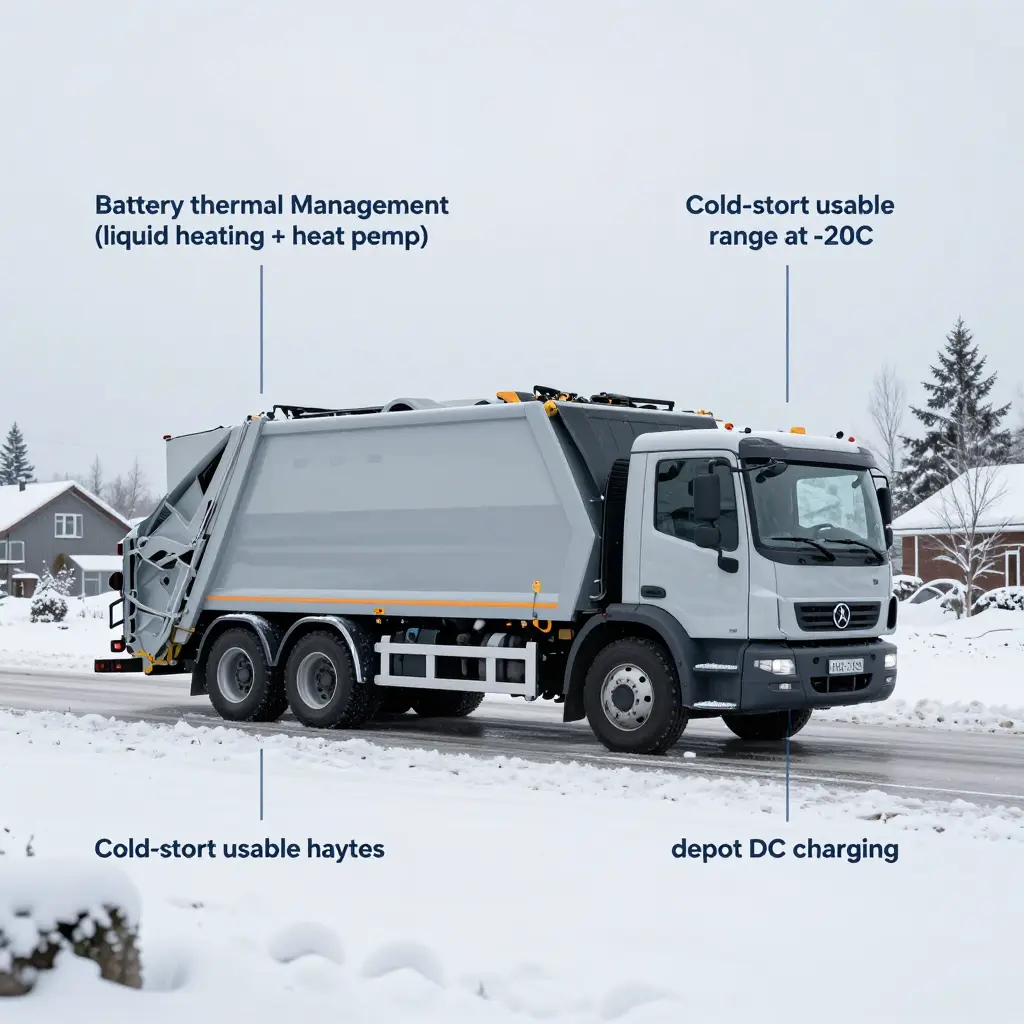
The four scoring pillars
Each pillar carries a hard pass threshold and a graded performance rating. The model is deliberately gated: a candidate that misses any single threshold is disqualified before the weighted total is even calculated, because on a cold route a weakness in one pillar cannot be offset by strength in another.
| Criterion | Weight | Pass threshold | Scoring basis |
|---|---|---|---|
| Cold-start usable range | 30% | >= 120 km at -20°C with heater on | Verified -20°C range test, not nameplate figures |
| Compactor duty cycle | 30% | >= 500 compaction cycles per shift | Sustained cycles/hour on a single charge |
| Battery thermal management | 25% | Active liquid heating plus heat pump | Cells held within a controlled 15-30°C window |
| Depot charging readiness | 15% | Overnight recharge in <= 8 h | 150-250 kW DC depot chargers, trucks per column |
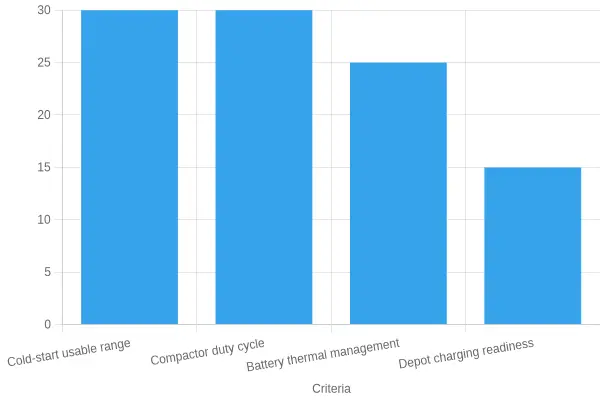
Apply the model on a 0-100 scale: award each pillar a 0-4 performance score, multiply by its weight, and sum. Set a minimum qualifying total of 70 points. When comparing specific models side by side, use a like-for-like product comparison rather than marketing summaries. For sourcing context, confirm that the shortlisted electric garbage truck candidates come from vetted, warranty-backed manufacturers with documented cold-climate references.
Score first, negotiate second
The framework converts a tangle of winter variables into a defensible, repeatable decision. A truck that clears all four gates with a total above 70 has demonstrably earned a place on Estonian winter routes; anything below is a maintenance risk disguised as a discount. At the tender stage, pair this weighted score with independent range-test data and a verified depot charging plan, then negotiate from evidence rather than enthusiasm.