
Why 1.6 m Aisle Width and Charging Windows Define the Specification
Narrow-aisle purchases often start with a truck: a make, a capacity, a mast height. The two numbers that settle the specification are the aisle the racking leaves you and the hours the truck can spend off the floor on charge. Those two decide truck class, battery capacity, fleet size and the throughput you can promise. Mast type and brake configuration follow from them; they do not lead.
An electric narrow aisle truck is a battery-powered lift truck built for racking aisles too narrow for a counterbalance machine, usually with a turret, reach or articulating mast. 1.6 m is the practical lower threshold at which such a truck can turn, pick and travel without striking racking or pallet overhang, which is why the aisle requirement in a facility survey resolves to that figure. A charging window is the interval in which a truck can be off the floor for recharging, fixed by shift patterns, breaks and available power.
Together they produce the narrow aisle specification: the dimensions, battery ratings and performance figures a supplier has to meet.
A machine that fits the aisle but cannot be recharged inside the shift will lose to a larger one whose battery matches the duty and whose charge cycle is shorter. Buyers who treat both figures as fixed inputs rather than points to negotiate finish the comparison of electric narrow aisle trucks sooner, and are less likely to end up with equipment that does not suit the building.
What follows is the survey work behind the aisle figure, the arithmetic behind the charging window, the trade-offs between them, and the clauses that belong in the tender.
How Aisle Width Is Measured – and Why 1.6 m Is the Threshold
Aisle figures on datasheets measure different things and cannot be swapped. The right-angle stacking aisle is the clear width needed to turn 90° from a travel lane into a rack face. The intersecting aisle is a crossing between two travel lanes, governed by truck width plus cornering clearance. The working aisle is the passage left for picking, inspection or pallet exchange. Only the stacking figure is fixed by truck geometry.
Measurement inputs
The stacking figure is the sum of three terms: outside turning radius measured to the face of the load, load length as projected at the governing lift height, and a stated clearance allowance. Turning radius follows from wheelbase and steer geometry. Mast tilt and carriage deflection push the load forward at height, so projected load length grows with lift height, while rear counterweight swing sets tail clearance. Battery compartment length and position shift the chassis centre of gravity, and with it the counterweight and tail swing.
Carry the clearance allowance, typically 75-100 mm per side, as its own line. It absorbs rack upright tolerance, load overhang and floor deviation, none of which is truck behaviour, and a single combined number cannot be audited against a site.
Verification on site
Confirm floor flatness in millimetres per metre; a surface outside tolerance adds lateral drift that the allowance has to absorb. Rail or wire guidance constrains that drift and can justify a smaller figure for a narrow aisle forklift, but only for guided travel and never for the stacking manoeuvre. Check overhead obstruction height against mast extended height plus load. Below 1.6 m at the required lift height, chassis-rotation steering stops being viable; the envelope calls for a turret truck or another very narrow aisle (VNA) machine, which rotates the load instead of the truck. Measure three aisles at rack-base level, not one, and compare the results against a verified narrow aisle forklift specification checklist before committing.
Three figures belong in the survey notes before any supplier is contacted:
- Aisle width written as turning radius + projected load length + clearance, with clearance kept on its own line.
- Floor flatness and overhead clear height, recorded before any reduction for guidance is accepted.
- The lift height at which the 1.6 m figure is checked, since below it the requirement describes a turret or VNA machine rather than a reach truck.
Reading the Aisle Width Measurement Diagram
The schematic reduces a narrow aisle to two dimensions: the clear distance between racking faces, and the clearance left on each flank once the truck is square in the aisle. Width is measured to the racking uprights at their most obstructive point, not to pallet overhang and not to floor line markings, which drift over time.
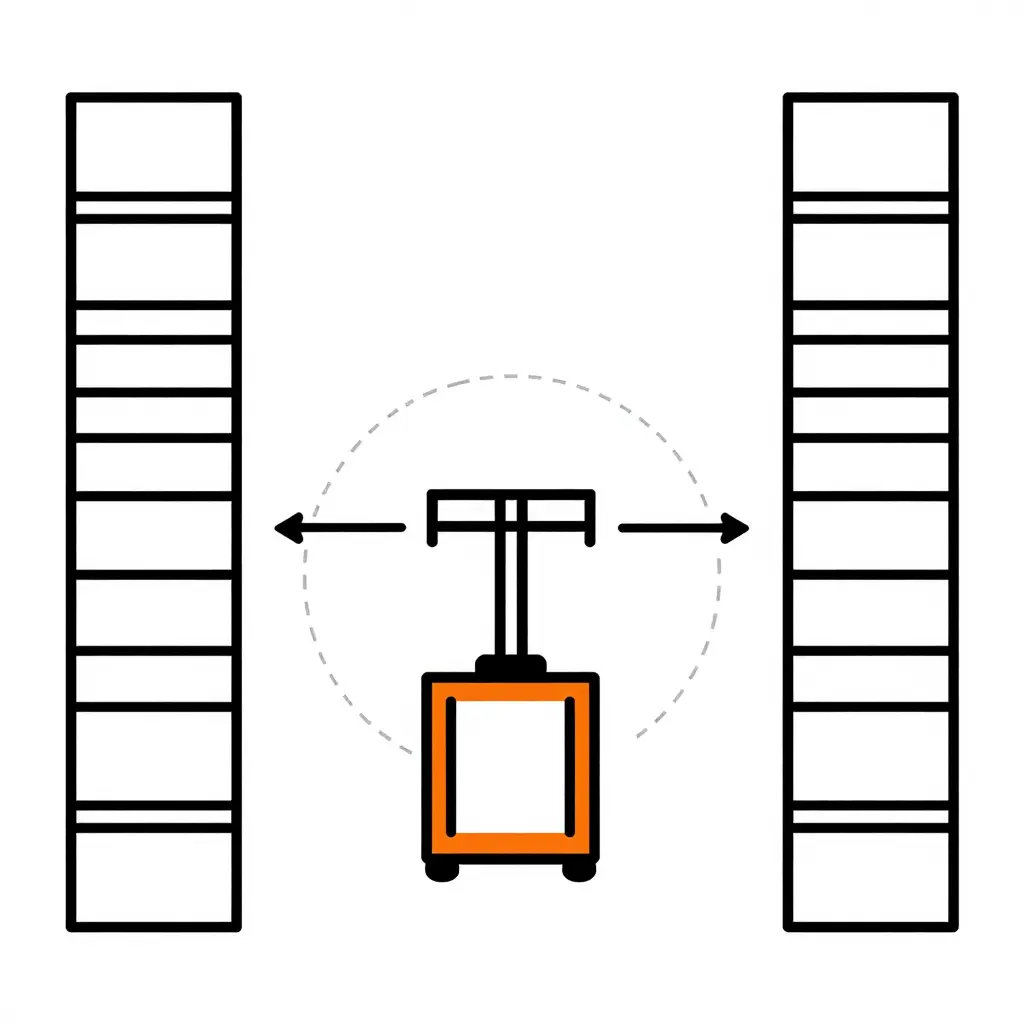
Figure: aisle width across the full span, and side clearance on each flank. The second number decides whether 1.6 m works or only looks as if it does.
A truck can fit a 1.6 m aisle and still clip the racking with its rear-swing arc on every pick. That is why figures from suppliers of electric narrow aisle trucks should be checked against measured, laden dimensions rather than nominal ones.
Data to Collect Before You Specify
Fill in the survey before comparing machines. Skip one variable, the true aisle width or the length of the charging window, and every downstream number is wrong by an amount nobody can see. Anyone comparing electric narrow aisle trucks should finish this list before signing.
- Clear aisle width at the narrowest point: sets the aisle width requirement and rules out any chassis that cannot clear it.
- Racking height and beam levels: fixes maximum lift height and the free lift needed at each pick face.
- Pallet and load dimensions, including overhang: determines load centre, fork length and rated capacity at height.
- Floor flatness and joint condition: governs wheel type and whether mechanical guidance is required.
- Ambient temperature range, if cold storage applies: drives battery chemistry and derated capacity.
- Overhead obstructions and sprinkler clearances: cap collapsed mast height and overhead guard profile.
- Number and duration of shifts: sizes the narrow aisle forklift battery against daily energy demand.
- Amp-hour consumption per shift: converts real duty cycle into usable capacity instead of nameplate figures.
- Available charging window in hours and when it occurs: decides battery capacity versus opportunity charging.
- Charger location and electrical supply capacity: set charger power rating and may change battery voltage.
- Required throughput in pallet movements per hour: translates into travel speed, acceleration and lift rates.
- Lift height at maximum load: confirms residual capacity, the figure that governs stability.
Required Aisle Width by Truck Type: Where the 1.6 m Threshold Falls
The chart plots indicative stacking aisle widths for the five common electric truck classes, with 1.6 m marked as a reference line, so the gap is readable at a glance instead of buried in a datasheet.
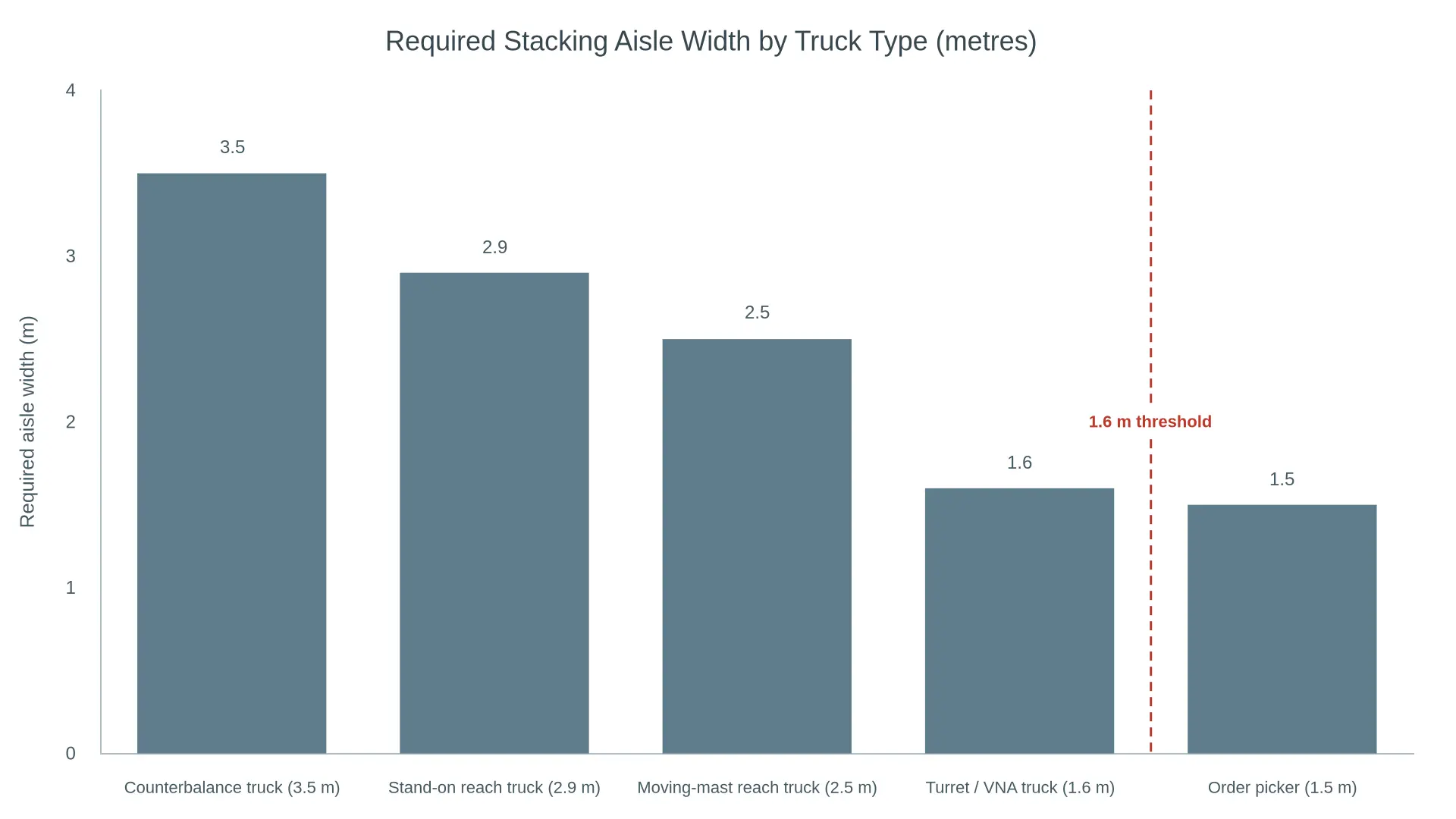
Figure 1: Indicative required stacking aisle width by truck type, with the 1.6 m threshold shown as a reference marker.
A counterbalance truck needs roughly 3.5 m, more than double the 1.6 m benchmark, which is why it rarely suits a high-density layout. Stand-on and moving-mast reach trucks close that gap but still sit above the line. Only turret/VNA trucks and order pickers land at 1.6 m or below, and that difference is what buys the extra pallet positions per bay. If the racking plan is still open, the wider guide to buying electric narrow aisle trucks is worth reading before you request quotations.
Caption note: The values shown are indicative and must be confirmed against the selected model’s turning envelope, including load length, fork overhang and any guide-rail or wire-guidance requirement.
Charging Windows: Sizing the Battery to the Shift, Not the Other Way Round
Defining the window
A charging window is the hours available for replenishment between one operating period and the next: eight hours for an overnight turnaround, twenty minutes for a mid-shift break, five to ten minutes for a battery exchange. Shift length, break schedule, dock and picking peaks, and the time the truck is genuinely idle all define it. The specification has to satisfy that window; a preference for overnight charging does not change it.
Amp-hour consumption per shift is built from three measurable elements: pallet movements multiplied by energy per lift cycle (a function of lift height and hydraulic losses), travel distance multiplied by consumption per metre, and accessory or attachment load. Meters on existing equipment give watt-hours per pallet movement, which converts directly to amp-hours at pack voltage.
Usable capacity is rated capacity multiplied by permitted depth of discharge, and the result still has to leave an acceptable end-of-shift state of charge: commonly 20-30% for lead-acid, deeper for lithium. Single overnight charging suits one-shift operations with long windows. Opportunity charging adds energy during breaks. Battery exchange decouples window length from pack size, at the cost of handling equipment and floor space.
Charger output, supply capacity and connector type all bound the window. Delivered energy is charger kilowatts × hours × efficiency; connector standards cap current; the site’s supply limits peak draw. Cold-storage ambient temperatures reduce usable capacity, so the same duty needs a longer window.
Matching charger output to window length
Take a truck that consumes 24 kWh in a shift. Spread across an eight-hour window, that averages 3 kW, so a 3.4 kW charger covers it at roughly 88% efficiency. Halve the window to four hours and the requirement doubles to about 6.8 kW. If supply or connector caps charging at 4 kW, the shortfall cannot be recovered inside the window. The battery then has to carry two shifts of energy, around 48 kWh usable, which changes weight, aisle dimensions and cost. Test advertised runtimes against this arithmetic when comparing electric narrow aisle trucks.
Use the table to rule out strategies that cannot fit your shift pattern before spending time on quotes or site surveys. Windows vary by site, so treat the times as planning envelopes rather than guarantees.
Charging Strategy and Battery Chemistry Comparison
| Battery chemistry / charging strategy | Typical full-charge time (hours) | Opportunity-charging tolerance | Charger and infrastructure requirement | Cycle life expectation | Best-fit shift pattern | Implication for truck specification |
|---|---|---|---|---|---|---|
| Flooded lead-acid, single overnight charge | 8-10 h, plus 8 h cool-down and weekly equalise | Low – one deep cycle per day; partial charges accelerate sulfation | One charger per truck bay in a ventilated battery room; 48 V DC output from a 3-phase supply | 1,200-1,500 cycles (approx. 4-5 years) | Single 8 h shift, five days a week | Specify 48 V / 625 Ah pack, battery-room ventilation and a charging bay per truck |
| Flooded lead-acid, opportunity charging | 8-10 h full; 15-30 min top-up adds roughly 10-15% SOC | Limited – cap at 2-3 partial charges per week | Chargers at pick faces and break areas, roughly one per 2-3 trucks | 900-1,200 cycles | 1.5 shifts or seasonal peaks | Specify high-frequency charger and per-battery monitoring to protect cycle life |
| Battery exchange with a second pack | 8-10 h per pack, but swap takes 5-10 min | Not applicable – energy is exchanged, not topped up | Centralised charger set plus crane or roller-bed handling in a battery room | 1,200-1,500 cycles per pack | Two or three shifts, near-continuous utilisation | Specify removable standardised pack, handling gear, duplicate pack capital and floor space |
| Lithium-ion, opportunity charging | 1.5-2.5 h full; 15-30 min top-up adds 30-50% SOC | High – partial charges are benign, no memory effect | One charger per 3-5 trucks, standard 3-phase outlet, no battery room | 3,000-5,000 cycles (approx. 8-10 years) | Two or three shifts with scheduled breaks | Specify 48 V Li-ion pack, matched opportunity-charging profile and break-time charging points |
| Lithium-ion, fast charging | 1-1.5 h full; 45-75 min to 80-90% SOC | High, but heat build-up requires thermal management | High-rate charger (0.5C or above) on a dedicated high-power circuit | 2,500-4,000 cycles | Continuous three-shift, high-throughput operation | Specify fast-charge-capable pack, active thermal management and site electrical capacity |
| Fuel cell or range extender | 5-15 min refuel; buffer pack held between 20% and 80% SOC | High – refuel during shift change rather than charge | Hydrogen supply or on-board generator, fuel storage, venting and code compliance | 3,000-5,000 cycles on a smaller buffer pack | Multi-shift, cold storage, or sites with limited electrical capacity | Specify hybrid architecture, fuel storage, dual-system maintenance and higher capex |
Full-charge time tells you whether a truck can be back in the aisle by the next shift. Opportunity-charging tolerance tells you how much of the window can be carved into short top-ups. If the measured window is under about 1.5 hours between shifts, only the lithium-ion fast-charge, battery-exchange and fuel-cell rows remain viable. For budget planning against the strategy you choose, see the breakdown of what it costs to charge an electric truck fleet.
The Trade-offs Behind a Narrower Aisle
Aisle width and storage density pull in opposite directions, and the cost does not move linearly. Converting a wide-aisle layout to a narrow aisle forklift operation usually returns a double-digit percentage increase in pallet positions per square metre, because every metre of aisle removed goes back to rack footprint along the entire run. The last few centimetres of aisle width carry the largest cost step: they tend to change truck class, guidance and floor specification, not just the layout.
Lift height works against payload. Residual capacity, the load an electric VNA truck can still handle at full elevation, falls as the mast rises, driven by mast deflection and load centre shift. Higher lift therefore forces a heavier chassis and counterweight or a published capacity derating curve, so the top tier may carry only a fraction of the nominal rating.
Very narrow aisle operation imposes guidance systems (rail, wire or magnet), reduced travel speeds, and floors held to tighter flatness tolerances over a defined length. Narrower clearances raise the risk of racking strikes, which puts more weight on operator training and anti-collision options. Battery compartment placement can also set minimum chassis width: side-extraction boxes add width that rear-extraction or onboard designs avoid.
Where the specification must compensate
- Capacity taken from the derating curve at the top tier, not the base rating.
- Floor flatness surveyed and remediated before guidance is installed.
- Training and anti-collision listed as line items rather than options.
Aisle width normally binds first, because the building and rack layout are fixed before any truck is quoted. Capacity derating at height binds second, and it is the constraint most often missed between enquiry and order. Floor condition and battery handling bind last, yet they tend to surface latest. Check electric narrow aisle truck specifications against whichever limit applies to your building.
The Charging Window, Not the Nameplate, Decides Feasibility
The obvious answer to a short charging window is a bigger battery. It is rarely the cheapest. What decides whether an electric narrow aisle truck completes a 24-hour cycle is the arithmetic between amp-hour consumption per shift and the minutes of charging time the operation can actually give back.
The chart below plots state of charge for one generic duty cycle under three strategies. The dashed line is a 20% floor, the reserve many fleets keep to protect lithium pack life and leave enough charge to reach a charger; the shaded bands are the charging windows. Only the curves that stay in the white space above that line are viable.
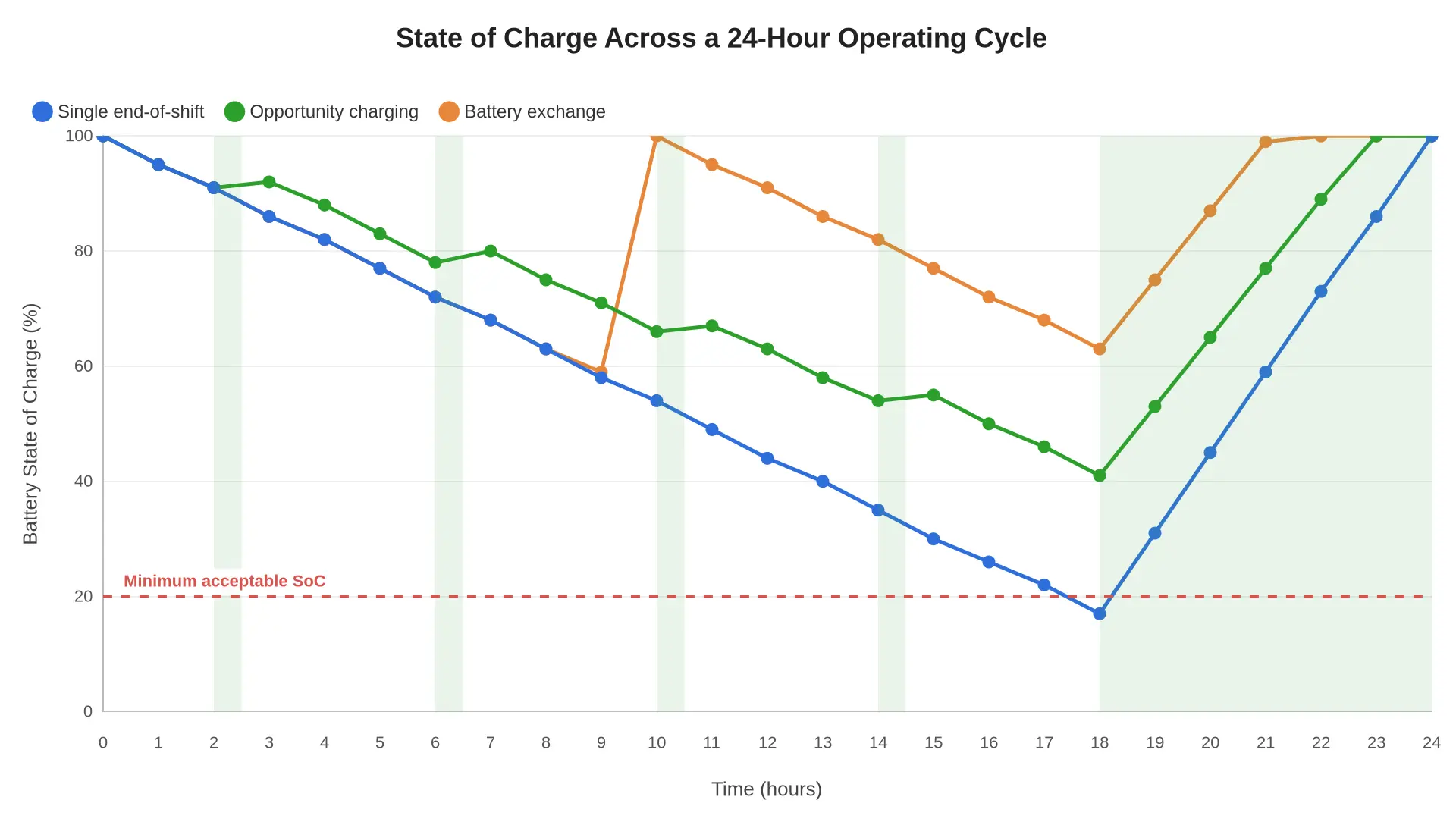
The curves represent a generic duty cycle and must be recalculated with the site’s measured amp-hour consumption before they are used to size a truck or a charger.
Reading the Three Curves
- Single end-of-shift charging (blue) starts at 100%, which looks safe on paper. With no energy returned until the shift ends, the pack crosses the 20% threshold roughly 30 minutes before the shift closes and bottoms out at 17%. The truck is parked and unproductive while the operator waits, or it is dragged off the aisle. Extra nominal capacity does not fix that if the overnight window is already committed.
- Opportunity charging (green) returns energy in four 30-minute breaks plus the overnight period and never lets the pack fall below 41%. The upward steps are small because break-area chargers are modest and half an hour is short: four top-ups return about 24% here, not the 30-50% a high-rate charger delivers in the same time. What has to hold is break discipline and charger placement near the aisle ends.
- Battery exchange (orange) resets to 100% at hour 10 on a freshly charged pack. It is the most robust curve and the most capital-hungry, since it needs a second battery, a change station and a manual or semi-automated swap routine.
| Strategy | Energy returned during shift | Charging window used | Lowest SoC | Threshold status |
|---|---|---|---|---|
| Single end-of-shift | 0% | 18:00-24:00 (6 h) | 17% at 18:00 | Crosses below 20% at ~17:30 |
| Opportunity charging | ~24% (4 x 30 min) | 02:00-02:30, 06:00-06:30, 10:00-10:30, 14:00-14:30, plus overnight | 41% at 18:00 | Holds above threshold |
| Battery exchange | 100% (fresh pack at 10:00) | Swap at 10:00; recharge 18:00-22:00 | 59% at 09:00 | Holds above threshold |
What This Means for Your Specification
Convert measured amp-hours per shift into a percentage of usable pack capacity, then divide by the charging rate your electrical infrastructure can actually deliver in the windows you control. If the resulting curve dips below your floor before the shift ends, there are three levers: opportunity charging, a second battery, or a shorter duty cycle. A larger pack helps only when the extra capacity covers the shortfall, and it adds weight, cost and aisle-loading consequences that matter in a 1.6 m aisle. Run the full electric narrow aisle truck specifications checklist before committing to a pack size.
Total Cost of Ownership: Where Aisle Width and Charging Windows Show Up in the Numbers
Two decisions carry most of the lifetime cost of electric narrow aisle trucks: how tight the aisle runs and how long the charging window is. Most other cost lines move a little when those two change.
Energy cost per operating hour depends on charger efficiency and on when the power is drawn. Tariff timing usually dominates the efficiency difference: a 92% charger running through a peak tariff can cost more per hour than a 96% unit on an off-peak window. The benchmark arithmetic is in this guide to electric truck charging cost.
Battery replacement interval tracks depth of discharge more than calendar age. Shallow opportunity cycling usually extends it; habitual deep discharge shortens it, which is why a scheduled battery health inspection pays for itself in planning certainty.
Charger and electrical infrastructure – service upgrades, transformer headroom, cabling, charger count – scales with charge rate, not fleet size.
| Cost line | Driven by | Direction |
|---|---|---|
| Energy cost per operating hour | charger efficiency, tariff timing | lower with off-peak windows |
| Battery replacement | depth of discharge, cycling strategy | longer with shallow cycling |
| Charger + electrical infrastructure | charge rate, service capacity | higher with fast charging |
| Floor prep / guidance install | aisle width at or below 1.6 m | higher with wire or rail guidance |
| Downtime risk | charging window length | rises sharply as window shrinks |
| Residual value | chemistry, cycle history | LFP and lead-acid diverge |
Narrowing to 1.6 m buys storage density, typically two to four additional pallet positions per bay pair, or a smaller building footprint. Against that sits floor preparation and guidance installation: flatness tolerances, wire or rail guidance, a real capital line that very narrow aisle operation imposes.
Downtime risk is where short charging windows bite. If the window drops below the recharge the duty cycle requires, trucks queue and the cost lands in labour, not energy. Residual value separates chemistries further: cycle history and chemistry move resale more than meter hours.

Left to right, each block is a decision that constrains the next.
- Facility data collection – building geometry, rack layout, floor condition and load profile.
- Aisle width confirmation – the 1.6 m working aisle that fixes the truck envelope; lift height comes from the rack, not the aisle.
- Truck class selection – reach, order picker or turret truck, matched to that confirmed aisle.
- Battery and charging window sizing – energy per shift translated into a charge window that fits your operation.
- Fleet sizing – truck count derived from throughput per hour against realistic availability.
- Final specification sheet – the consolidated document released to tender.
The order matters. Charging window sizing sits after aisle width, because the truck class chosen for a 1.6 m aisle fixes battery voltage, capacity and the swap-or-plug decision. Reverse those two and you size energy for a truck you cannot physically deploy. For a full walkthrough of each stage, see the guide to buying electric narrow aisle trucks.
Writing the Specification: Clauses That Protect the Buyer
A narrow aisle specification is worth the paper only if every figure can be checked. Write the tender so a performance claim is also a contractual commitment, and check each number yourself instead of accepting the datasheet.
- State measured aisle width and clearances separately. Record the verified aisle width as one figure, then list mast, load, overhead-guard and body clearances individually, so no supplier can satisfy the requirement with an averaged number.
- Require the calculated turning envelope and residual capacity at maximum lift height. Ask for the calculation rather than a claim, because residual capacity falls as the mast rises and an unverified figure transfers that risk to the buyer.
- Fix the charging window in hours and the end-of-shift state of charge. Specify, for example, a 1.5-hour window and a minimum 40% state of charge at handover, so opportunity charging fits your shift pattern instead of the supplier’s default.
- Define the acceptance test for throughput and charge recovery. Set pallet movements per hour, load condition, measurement method and witnessed recovery time to a stated state of charge. Acceptance criteria nobody can measure cannot be enforced.
- Require written cycle-life, warranty and support terms. Put battery cycle life at a defined depth of discharge, warranty duration in years and cycles, documentation language, spare parts availability and operator training hours in the offer. These determine total cost of ownership long after delivery.
Frequently Asked Questions
Is 1.6 m a minimum or a target aisle width?
1.6 m is a minimum operating aisle width, not a target. It is measured between rack uprights and assumes the truck’s actual right-angle stack plus steering and load-shift clearance; most suppliers reserve 75-100 mm per side. Treating 1.6 m as a goal leaves no tolerance for floor joints, worn tyres or load overhang.
Can a truck specified for a 1.8 m aisle run in a 1.6 m aisle after racking changes?
No. A truck dimensioned for a 1.8 m aisle should not be operated in a 1.6 m aisle after racking changes without written confirmation from the manufacturer. The 200 mm reduction removes 100 mm of clearance per side, and the limiting figure is usually the right-angle stack, not chassis width. Check the revised aisle width requirement against the data plate and load chart.
How is the required charging window calculated from daily amp-hour consumption?
Divide daily amp-hour consumption by the charger’s rated output current, then add 15-20% for inefficiency and balancing. A truck drawing 480 Ah per shift on an 80 A charger needs six hours at rated output, about seven hours allowing for losses, plus an equalise charge. Size the battery charging window on the highest-consumption day, not the average.
Does lithium-ion eliminate the need for a charging window?
No. Lithium-ion shortens the battery charging window but does not remove it. Higher acceptance rates allow opportunity charging during breaks, yet cells still need a full periodic charge and balancing, typically 3-5 hours weekly for a 48 V/400 Ah pack on a 100 A charger. Operations running 20-hour schedules still need a defined charging slot per truck.
What happens to lift capacity when aisle width is reduced?
Residual capacity falls with lift height and load centre, and the truck classes that work in narrower aisles generally start from a lower base rating, with less counterweight and a slimmer chassis. That is why a truck rated 1,500 kg for a 1.8 m aisle may be rated 1,200 kg once the aisle narrows to 1.6 m and lift reaches 5,000 mm. Always read the derating curve at your actual lift height, not the headline figure.
Which measurements must be re-verified before the purchase order is signed?
Re-verify clear aisle at floor level and at 2 m, rack beam heights, sprinkler and ceiling clearance, floor flatness, column projections, door and intersecting-aisle widths, and load weight. These set the final aisle width requirement. Confirm them with the supplier in writing, on site, before signing, and check the truck against measured rather than planned dimensions.
The Specification Checklist
Measured aisle width at the narrowest travel point determines the truck class you can deploy. The charging window available between shifts determines battery capacity and charger sizing. Fix and document both before requesting or comparing prices, because quotes built on different assumptions are not comparable.
- Confirm measured clear aisle width at the narrowest point, including rack and pallet overhang.
- State the required lift height and the residual capacity at that height, not the rated maximum.
- Record the charging window in hours, including breaks and weekend stoppages.
- Match battery capacity and charger output to that window, then confirm whether opportunity charging is viable.
- Verify throughput demand in pallet movements per hour against truck travel and lift speeds.
- Confirm that floor flatness, surface condition and guide-path or rail requirements suit the chassis.
- Check cold-storage, wash-down or hazardous-area ratings where the environment demands them.
- Obtain written confirmation of each figure from the supplier, and compare prices only where the parameters match.
For non-standard aisle or charging conditions, custom configurations are available, and the electric work trucks for sale range shows how specification variants are handled.